
Live Casino Lightning Roulette in the UK: How It Works
 Available in GB
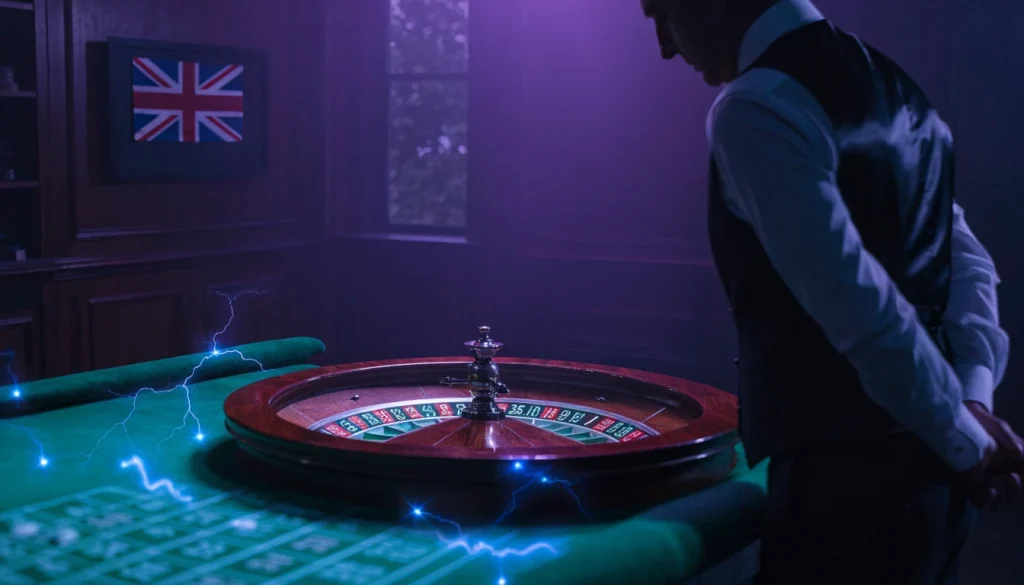
A look at the live studio format, how Lightning Roulette sits within an online casino, and what to consider before playing.
The Live Casino Room Behind the Wheel
Lightning Roulette belongs to a familiar but relatively young part of online gambling: the live casino, where a game is presented as an event unfolding in a studio rather than as a sequence of computer-generated results. The distinction is partly technical and partly social. A traditional digital lobby can make a table game feel like a piece of software; a live room borrows the visual language of the casino floor, with a wheel, a table and a human presence at the centre.
That format did not arrive fully formed. Online casinos first made table games available through digital interfaces, translating established rules into buttons, screens and automated outcomes. Live games added another layer: the sense that play was taking place somewhere, in real time, even though the participants were separated by distance. The result is neither a return to the old casino nor simply another screen game. It is a carefully staged middle ground.
A UK marker in that development came in 2013, when Grosvenor unveiled live casino games that included Blackjack, Texas Hold’em and Roulette, alongside other card and casino games. The significance is not that one launch tells the whole history of the format. It shows, more modestly, how a recognisable casino name brought live tables into an online setting and presented several kinds of game together. The menu itself mattered: a casino room was not only a roulette wheel, but a collection of different table traditions.
Those traditions carry different social rhythms. Roulette turns attention towards a wheel and a ball; blackjack centres on cards and decisions made against a dealer; Texas Hold’em gives the cards a more explicitly competitive role among players. A live casino gathers these forms under one roof, even when that roof is a digital lobby. The games share a setting, but not a pace or a culture. Some invite quiet observation; others make each decision feel conspicuous.
Casino Games in the UK: Slots, Live Games and More
Lightning Roulette sits within the roulette tradition while giving it a distinctive identity. The name signals an amplified version of a game already associated with anticipation: the wheel spins, the ball travels, and attention narrows towards where it might settle. In a live casino, that familiar structure is framed as a shared occasion, rather than just a set of choices displayed on a screen. The appeal is not hard to understand. Roulette has always made waiting part of the spectacle.
The broader UK live-casino setting is therefore useful context for the game. It helps explain why Lightning Roulette is encountered alongside card tables and other casino formats, rather than as an isolated novelty. The live room borrows the casino’s old organising idea—a place where different games coexist—and adapts it for online access. The physical room is absent, but the sense of a programme of tables remains.
There is a small cultural bargain in that arrangement. The online player gains the theatre of a table without entering a public gaming room; the operator gains a format that can make a digital catalogue feel less abstract. Neither side needs to pretend that a screen is a casino floor. The resemblance is enough.
Online casinos without ID in the UK: what to expect
A live casino is best understood, then, not as a single game type but as a way of presenting games. Roulette, blackjack and poker-like card play retain their separate rules and histories, while sharing a live setting. Lightning Roulette makes most sense within that larger room: one wheel among several traditions, carrying the old suspense of roulette into a newer form of casino entertainment.
Recommended online casinos
- SlotoSportBonus: 500% up to £ 10 200+ 777 FS · Payout speed: 1-3 business days
- x3betBonus: Welcome Pack 100% Up to £1.000 + 200 Free Spins · Payout speed: 1-3 business days
- AmunbetBonus: Join now and get 450% up to 2,700 GBP + 450 FS · Payout speed: 1-3 business days
- WinBeastBonus: €5000 + 500 FS + €650 Freebet · Payout speed: 1-3 business days
- NightLuckBonus: Welcome Pack + 805% Up To 6400€ + 280 FS · Payout speed: 1-3 business days
- ZombillionBonus: Welcome Pack 250% up to £4000 + 200 FS · Payout speed: 1-3 business days
- DieselwinBonus: Welcome Pack 250% up to £4000 + 200 FS · Payout speed: 1-3 business days
Finding Lightning Roulette in an Online Casino
The presence of Lightning Roulette in a game lobby says nothing, by itself, about whether the casino may lawfully offer it to people in Great Britain. A game title is a product label; permission to provide remote gambling is a matter of regulation. The distinction is less entertaining than a glowing wheel, but more consequential.
The UK Gambling Commission oversees commercial gambling in Great Britain and is the sole regulator for that activity there. Its remit reaches online gambling as well as venues with physical premises. For remote gambling, the location of a company’s key equipment does not remove the obligation: an operator serving consumers in Great Britain must hold the relevant Commission licence. A business based elsewhere cannot treat geography as an exemption.
Licence Verification
Step 1: Locate the licence number
Find the operator’s licence number on the casino website or in its legal information.
Step 2: Access the public register
Visit the Gambling Commission’s public register to search for the provided number.
Step 3: Verify the business identity
Ensure the record matches the business actually responsible for the casino, not just a similarly named company.
That makes licence verification the first task when considering online casinos with Lightning Roulette. The Commission’s public register is the place to check, rather than relying on a badge displayed on a casino website, a search result, or an assurance in promotional copy. Before depositing, locate the operator’s licence number and look it up on the register. The number should lead to a record for the business actually responsible for the casino, not merely to a similarly named company.
Names are not always neat. A site may present one brand to customers while its legal operating company appears under another name. The register should therefore be read as a link between the brand, the responsible business and the permission held—not as a catalogue in which a familiar label is enough. If a casino gives no clear account of which company operates it, the gap matters. A polished lobby cannot supply the missing legal identity.
A useful check is to compare the registered business details with the operator’s own terms and legal information. The casino’s pages should identify the company behind the service and provide a licence reference that can be checked independently. The register entry should correspond to that entity. If the brand name, company name or stated domain does not align, the difference calls for clarification before money changes hands. Similar names are not proof of a shared licence.
The scope of permission also matters. A record associated with a business is not a general certificate for every gambling activity it might advertise. The relevant question is whether the operator holds permission to provide remote gambling to consumers in Great Britain. Reading the register entry alongside the operator’s own identification details helps establish whether the licence belongs to the service being considered, rather than to an unrelated company or a different operation.
Live Baccarat Online Casinos in the UK: How to Choose
The Commission grants operating licences to businesses and personal licences to individuals involved in operating gambling in Great Britain. Those are distinct forms of authorisation. A named individual’s personal licence is not a substitute for the operating licence required by the business offering the casino. Equally, a casino’s statement that a person connected with it is licensed does not establish that the company itself has the necessary permission. The business record is central.
This framework explains why a list of Lightning Roulette casinos, however confidently assembled, cannot settle the legal question. Availability can change, brands can sit under different corporate names, and a game listing does not establish the status of the operator. A current register check is more useful than a ranking because it tests the specific business and service at the point they are being considered. It is verification, not endorsement.
The Commission’s role is not to certify a casino as suitable for every player, nor does an entry mean that every claim made by an operator should be accepted without thought. It establishes a regulatory relationship and the relevant permission. That boundary is worth keeping clear: a licence check answers whether the operator has the required authorisation, not whether the game is enjoyable, whether the site suits a particular person, or whether its presentation is persuasive.
For a search for Lightning Roulette online in the UK, the sound order is therefore plain: identify the legal operator, obtain its licence reference, and check the business on the Gambling Commission’s public register before depositing. If the record cannot be matched confidently to the casino, uncertainty is not a technicality to be waved away. The wheel can wait.
Do
- Check the Gambling Commission’s public register
- Verify the legal operating company name
- Confirm the operator holds remote gambling permission
Don’t
- Rely on badges displayed on the website
- Trust promotional copy or search results
- Assume a personal licence substitutes for an operating licence
An Online Casino Is More Than a Game Lobby
A casino’s lobby is designed to make games visible. It is less revealing about the organisation behind them. Lightning Roulette may be the reason a player arrives, but an account is a continuing relationship: personal details are submitted, account terms apply, and questions may arise that have nothing to do with the wheel. The practical task is to understand who is on the other side of the screen and how the account will work before money is placed there.
That is a different exercise from establishing whether an operator holds the required authorisation. The Gambling Commission’s register is the relevant public record for that check; once the regulatory question has been addressed, the site’s own account information still deserves close attention. A polished lobby, familiar game titles and confident marketing are not substitutes for clear answers about the business managing the account.
A useful first test is consistency. The name presented on the website should make sense alongside the name used in account terms, privacy information and customer correspondence. If several names appear, the relationship between them should be explained rather than left for a player to infer. A company may use a trading name, but an account holder should be able to identify the legal entity responsible for the service. Ambiguity at this basic level is not proof of wrongdoing; it is a reason to pause rather than treat branding as evidence.
Live Dream Catcher Casino in the UK: What to Check
The same standard applies to the stated domain. A link reached through an advertisement or a message should lead to the expected site, not to a lookalike address with a slightly altered spelling. This is an old problem wearing newer clothes: gambling has always depended on trust in the party holding the stake, while the online version can make a false front remarkably neat. The design may be convincing. The address still matters.
The dated detail around LuckyPays illustrates why brand recognition should not do the work of verification. A specialist review’s account of a check of the Gambling Commission’s public register, dated 26 September 2026, says no entry appeared under the LuckyPays name or the stated domain, including luckypays.io. That is a time-specific observation, not a permanent description of a changing register. It should not be converted into a claim about every site using a similar name, nor should a familiar-sounding brand be treated as proof of a connection. The precise name and domain are the point.
Account terms are another window into the operator’s habits. Before registration, the rules should be accessible and written plainly enough to explain what happens when an account is opened, information is requested, or a service is disputed. Dense legal language is sometimes unavoidable; evasive presentation is not. If a key condition appears only after several layers of navigation, or the terms refer to a different company without explaining why, the difficulty is practical as well as stylistic.
Privacy information deserves similar attention. An account involves personal information, and the privacy notice should identify how that information is handled and who is responsible for it. The notice need not read like a friendly conversation, but it should be specific enough to be useful. A generic assurance that data is protected says little if the business providing the service is unclear.
Consistency between the brand name, the legal operating company, and the registered domain is a key indicator of a transparent service.
There is also a distinction between a functioning lobby and a functioning account service. Registration should not be treated as complete merely because the games load. The account area should make basic records and account information intelligible, while help material should explain how to contact the operator and what information may be needed to resolve a query. This is not a promise that every interaction will be effortless. It is a way of seeing whether the site has considered the ordinary business of being an account holder.
Promotional language can make a casino appear more definite than its underlying arrangements. Terms, privacy details and company information are quieter documents, but they carry more weight when questions arise. A Lightning Roulette table can be a striking entrance. It cannot, by itself, establish the credibility of the house around it.
The First-Person View: Closer to the Table, Not a Different Game
A first-person presentation changes the angle from which Lightning Roulette is encountered. Instead of watching a conventional live-camera view, framed like a broadcast across a table, the player is placed nearer to the action: the wheel and its surrounding space occupy the visual field as though seen from a position at the table. The effect is one of proximity, not participation in a new set of rules.
That distinction matters because viewpoint can feel like agency. A close perspective may make the wheel seem more immediate, and the session less like watching a studio feed from elsewhere. But the image does not give the player control over the wheel, nor does it turn the presentation into a different roulette game. The format is a way of staging what is seen.
UK online casino payouts: understanding RTP claims
The conventional live-camera view has a familiar social grammar. A wider frame can show the dealer, table and room together, making the session legible as a broadcast from a shared setting. A first-person view narrows that distance. It gives visual priority to the player’s imagined position rather than to the room as a whole. The trade-off is plain: greater closeness, less of the surrounding scene.
This is why “first person” should be understood as a description of presentation, not a promise that the experience becomes physically equivalent to sitting at a casino table. A screen remains a screen. It can organise attention and suggest a point of view, but it cannot supply the weight of the room, the small delays of shared presence or the unplanned exchanges that make a public table feel social. The perspective can be intimate without being intimate in the human sense.
In a first-person Lightning Roulette casino game, the familiar identity of the product remains the anchor. The change is how that identity is framed. A player considering the first-person version is choosing between modes of seeing: a closer, more concentrated view or the broader visual language of a conventional live feed. Neither angle, by itself, says anything about the quality of a session or makes its outcomes more predictable. A camera is not an advantage.
The distinction also explains why first-person presentation should not be mistaken for a separate ruleset. The view may influence how readily a person follows the action, where attention settles, and whether the game feels immersive or distant. Those are matters of perception. They do not alter the underlying game. The wheel does not become a different wheel because the camera appears to stand nearer.
Difference between views
A conventional live-camera view provides a wider frame showing the dealer, table, and room, while a first-person view narrows the distance to provide a more concentrated, table-level perspective.
For Lightning Roulette in the UK, the phrase “first person” therefore points to a visual choice within the experience, not a special class of roulette. It can suit someone who prefers an immediate, table-level perspective; another may find the wider view more informative or simply more comfortable. The label describes the frame, not the certainty of what lies beyond it.
Closer, not closer to control.
Choosing an Online Casino Without a Ranking
A casino offering Lightning Roulette can look persuasive in a polished lobby and still be difficult to assess as a place to play. The useful comparison begins after the game has caught the eye: with the terms attached to wagering, the account controls available, and the route for resolving a dispute. These details are less theatrical than a live wheel. They matter for longer.
Terms deserve more than a glance at a headline offer. The conditions should explain what applies to deposits, withdrawals and any promotion, in language that can be followed without guesswork. A vague promise is not a substitute for a stated rule. If a bonus is involved, its conditions should make clear when it can be used and what restrictions attach to funds. The point is not to find the most generous wording, but to understand what the wording permits.
Account controls offer another basis for comparison. Financial limits should be accessible within the account rather than buried behind a chain of menus, and the operator should explain how those controls work. A casino’s design tells its own story: whether it treats restraint as an ordinary part of the service or as an inconvenience to be hidden. That is a practical distinction, not a decorative one.
French Roulette Online Casinos in the UK
The complaints route is equally revealing. UK Gambling Commission licensees must provide an internal process for complaints and access to an approved Alternative Dispute Resolution service. The relevant information should be findable before a disagreement arises, with a clear account of how a complaint is submitted and what happens next. A policy that exists only in legal small print may satisfy the urge to publish, but it does little to make a process legible.
Comparisons should also separate the live game from the casino around it. Lightning Roulette may be the same named title across different lobbies, while the surrounding terms, account tools and customer-service arrangements belong to the operator. A striking presentation cannot answer questions about those arrangements. Nor does a busy game catalogue, by itself, say much about how clearly a casino handles its obligations.
A sensible assessment therefore has several parts: readable terms, usable account controls, and an intelligible complaints process. These can be weighed according to what matters most in a particular situation, without pretending that one feature settles every other question. The label “best” tends to flatten those differences into a single verdict. For a real-money casino, that verdict is less useful than knowing exactly what the operator’s own rules say.
No ranking can replace attention to those details. The wheel may provide the spectacle; the surrounding service determines the conditions under which it is offered. Any decision to play should remain bounded by what can be afforded to lose.
Roulette, Not a Slot: What the UK Stake Cap Means
The word “casino” covers games with very different structures. A slot generates play through repeated game cycles; roulette is a table game, whether its wheel is shown in a live-casino room or represented on screen. That distinction matters when a stake cap is discussed. Lightning Roulette belongs to roulette, not to the online-slots category simply because it is played through a digital interface.
Stake Cap Distinction
Online slot stake limits (£5 for age 25+ and £2 for age 18-24) do not apply to roulette or blackjack.
A specialist casino review sets out the Great Britain slot limits as £5 for a single game cycle when the player is aged 25 or over, and £2 for those aged 18 to 24. The same review says those limits do not extend to roulette or blackjack. These figures describe the slot category in that account; they are not a stake scale for every casino game.
The distinction is about classification, not appearance. A screen can make a slot and a roulette table look equally modern, animated and easy to access. Yet the regulatory treatment referred to in the review turns on what kind of game is being played, rather than the fact that both happen online. Calling Lightning Roulette a casino game does not make it a slot, and the slot cap should not be carried across to it by association.
That does not mean roulette has no other conditions. It means only that the particular limits cited for online slots are not the limits for roulette. A player considering the Lightning Roulette casino game in the UK should therefore avoid treating the slot figures as a guide to a roulette stake. The game’s category is the dividing line here.
This is a narrow distinction, but a useful one. Product labels often blur together in a lobby; the rules do not necessarily follow the lobby’s visual arrangement. A roulette table remains roulette when presented digitally. A slot remains a slot, with its own limits.
Online Bingo in the UK: Rooms, Patterns and Slots
The practical point is modest: the online slot cap is not a general ceiling for every game offered by an online casino. Nor does the distinction make a roulette stake harmless. Money placed on the table can still be lost, regardless of category or presentation. Only gamble what can be afforded to lose.
Trying a Demo Before Playing for Money
A demo can make Lightning Roulette easier to picture before any real-money decision is involved. Where a casino offers a playable version, it can show how the table is presented, where information appears on screen and how a round unfolds. That is useful for judging whether the visual pace and layout make sense, rather than trying to infer them from a game description.
The experience may also help distinguish the game’s added Lightning feature from the familiar roulette setting around it. A player can observe how the feature is introduced and how its results are displayed, without treating a demonstration as evidence of what a later session will produce. A simulated round is a sample of presentation, not a forecast. The wheel has no memory, and a demo cannot make chance more legible than it is.
There is a limit to what the exercise can establish. A demo cannot show how a real-money session will feel when the stake matters, nor can it promise that every casino presents the game in the same way. Screen arrangement, labels and other details may vary. Nor does finding a demonstration somewhere establish that a particular operator currently offers one; availability needs to be checked at the casino itself.
Trying a Demo
- Locate a playable demo version at the casino
- Observe the Lightning feature’s introduction
- Evaluate the visual pace and layout
- Check the sequence of a round
That distinction matters in the UK as much as anywhere. The phrase “Lightning Roulette demo” describes a way of trying a game, not a guarantee that a free-play version is available at every online casino. Some operators may provide a demo, while others may not. The absence of one says little about the game itself.
A careful trial is best treated as orientation: a chance to see whether the presentation is clear and whether its pace suits the person watching. It is not a test of skill or a method for discovering a reliable pattern. The bright feature can make the table feel more eventful; it does not turn random outcomes into information about what comes next.
If a demo is available, it can answer modest questions about the feel of the screen and the sequence of a round. It cannot settle questions about a real-money session, guarantee identical presentation elsewhere or suggest that a favourable result is due. The boundary is simple. A preview, not a promise.
Any later decision to play for money remains a separate one, and gambling should be limited to what can be afforded to lose.
What ‘Best’ Can Mean Without a Best-Casino List
“Best” sounds like a verdict, but with Lightning Roulette it often conceals a preference. One player may mean a table that feels easy to follow; another may care more about how the game is presented, or whether the surrounding casino feels straightforward to use. These are not interchangeable standards, and a single winner cannot settle them.
The phrase “best Lightning Roulette casino UK” therefore needs a second thought: best for what? The game remains Lightning Roulette wherever it is offered, but the experience around it belongs partly to the casino. A polished lobby may matter to someone who moves between games; someone interested only in this table may see little value in that polish. Neither preference is a universal measure.
Online European Roulette in the UK: Rules and Odds
There is also a difference between “best” as personal fit and “best” as an evidence-based claim. A ranking implies that the casinos were compared using a common method and that the results support the order shown. Without that method, the label is decoration. It may still be useful as shorthand for an opinion, but it should not be mistaken for a settled fact.
The year attached to the phrase—“best Lightning Roulette casino UK 2026”—does not make the judgement objective. It signals that the question is being asked in a particular moment, while the meaning of “best” remains dependent on the person making the choice. A recommendation that suits one set of preferences can be irrelevant to another. The calendar cannot repair that mismatch.
The more useful distinction is between a casino being suitable and being superior. Suitability asks whether its offer matches a person’s priorities. Superiority would require a defensible comparison across the same standards, not merely confident wording. That distinction matters because “best” can make a preference sound like a finding.
Even usability is not a neutral quality. A design that feels clear to one person may feel crowded to another; a broad range of games may be welcome or simply beside the point. The label compresses these differences into one tidy word. It is tidy in the way a drawer is tidy after everything has been pushed inside.
A sensible meaning of “best” is therefore local: best against stated priorities, not best for every player in the UK. That leaves room for judgement without pretending it is universal. And no description of suitability changes the basic risk of gambling: only money that can be afforded to lose should be wagered.
Choosing a Casino
- Prioritise readable terms over headline offers
- Ensure financial limits are easily accessible
- Verify the existence of an internal complaints process
- Match the operator’s suitability to your personal priorities
- Only wager money that can be afforded to lose
The Dealer’s Place in a Live Roulette Session
In a live-dealer Lightning Roulette session, the dealer is not merely a moving detail behind the wheel. The person gives the game its visible human centre: handling the roulette ritual, keeping the round legible and marking the transition from one turn to the next. The screen may be built from cameras and software, but its social grammar is recognisable from a casino floor. Someone is present, and the game is being conducted rather than simply animated.
That presence matters because roulette depends on ceremony as much as calculation. The wheel turns; attention gathers around its movement; the result settles into view. A dealer’s gestures make those events easier to follow and lend them a sense of order. This does not make the outcome more predictable, nor does it give the dealer control over what the wheel produces. The human role is presentational and procedural, not prophetic.
Online Casino Tournaments UK: Formats and Rules
Lightning Roulette adds its own visual emphasis to the familiar roulette setting, but the dealer remains part of the live table rather than a character in a separate game. The format’s distinctive effects do not turn the person conducting the round into a guide, adviser or source of privileged knowledge. A dealer can make the sequence feel composed; the wager and result still belong to the game’s rules.
The camera also changes what “company” means in online play. There is no shared room in the ordinary sense: participants occupy separate screens, while the dealer appears as a common point of attention. The performance is directed towards that dispersed audience, even though no individual player is physically across the table. It is a modest piece of theatre, with a wheel in place of a stage.
This is distinct from Lightning Roulette’s first-person presentation, where the emphasis is on the player’s apparent position within the game environment. A live-dealer view keeps the human operator and physical table in the frame; a first-person view foregrounds a designed viewpoint. Neither alters the underlying game. One shows the ceremony from outside it. The other brings the camera closer.
Online Casino American Roulette in the UK: What to Check
Playing Online: Deposits, Limits and a Clear Exit
Playing Lightning Roulette online in the UK involves more than choosing a table and making a deposit. The account is the boundary between a game and a financial commitment, and its safeguards matter before the first wager is placed.
Age verification must take place before an operator allows a customer to deposit. New customers must also be prompted to set a financial limit before their first deposit, with account-level controls available afterwards. These tools are most useful when they are treated as part of the account’s ordinary workings, rather than as emergency fittings hidden away until a session has gone wrong.
Payment rules set another boundary. UK-licensed casinos cannot accept credit cards for gambling, including credit-card funds routed through a money service business. A wallet cannot be used for gambling if it allows credit-card money to fund the payment. The distinction is not cosmetic: a payment method should not turn borrowed credit into a wager by passing it through another service.
Limits can help contain spending, but they do not make gambling harmless or ensure that a session ends as planned. A clear exit includes the ability to stop play and, where needed, use self-exclusion. UK-licensed operators must provide responsible-gambling tools, including self-exclusion. GAMSTOP offers a route to exclude from gambling sites licensed in Great Britain; it is a more substantial step than simply closing a game window.
There is also a route for disputes. Licensed operators must have an internal complaints process and provide access to an approved Alternative Dispute Resolution service. Keeping a record of the issue and the operator’s response can make that process easier to follow. Complaints procedures are not a substitute for stopping play when gambling is causing harm, but they do give customers a formal way to challenge how an operator has handled a matter.
The practical principle is less dramatic than the game’s name: gambling should use only money that can be afforded to lose. If that condition no longer holds, the sensible move is to leave the table.
What are the online slot stake limits in Great Britain?
The limit is £5 per game cycle for adults aged 25 and over, and £2 for adults aged 18 to 24. These limits do not apply to roulette or blackjack.
Are online casino games licensed and regulated?
Yes. The UK Gambling Commission regulates commercial gambling in Great Britain, including online casinos, and remote operators serving Great Britain consumers must hold the relevant licence.
Is LuckyPays licensed by the UK Gambling Commission?
The Commission’s public register dated 26 September 2026 does not show an entry for LuckyPays or its stated domain, luckypays.io.
Casino Games
Published by the Skrill Casino team.