
Online Bingo in the UK: Rooms, Patterns and Slots
 Available in GB
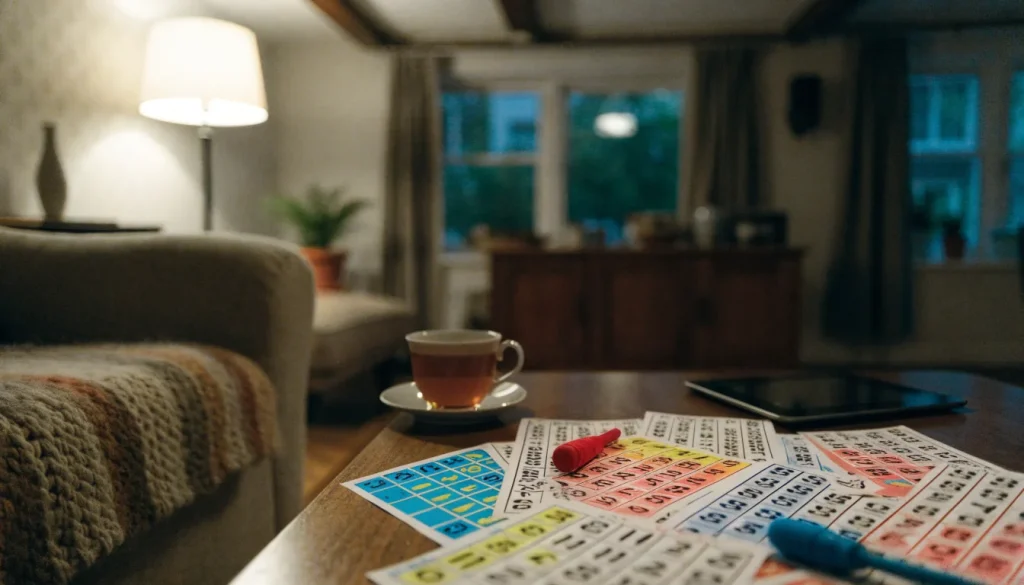
Bingo is a contest of tickets, draws and shared patterns, while slots follow a different game structure.
Bingo’s Patterns, and the Rooms Built Around Them
Online bingo begins with a small bargain: a player buys a ticket, numbers are drawn, and a prize depends on completing a pattern before the other players do. The screen changes the setting, but not the central arrangement. A ticket is a map of possible matches; the draw gradually marks it; the room is where separate maps compete against the same sequence.
That simplicity has helped bingo travel between social settings and commercial ones. Its rules are visible at a glance, yet the shape of a ticket changes what counts as progress. In a casino setting, bingo sits alongside games built on different rhythms, but it keeps its own grammar: numbers arrive, patterns take form, and the first completed claim wins. The distinction matters. Bingo is not merely a label for any game offered by an online casino; it is a particular contest between tickets, draws and other players.
Three patterns of play
The familiar 90-ball format gives each ticket three rows and nine columns. Prizes are attached to successive stages: completing one line, then two lines, then the full house. The draw has a built-in narrative. A ticket may be close to its first line while another is already approaching the final one; the same numbers can make one player’s card look promising and leave another’s untouched.
That sequence also makes 90-ball bingo easy to follow without turning it into a solitary puzzle. The prize stages are shared landmarks. A line is an event in its own right, not just a step towards the full house, and the room’s attention can move from one threshold to the next. The format gives the draw room to develop. Patience is part of the design.
80-ball bingo changes the shape of the ticket and the language of a win. Its grid has eight columns and four rows, and prizes can be tied to coloured patterns: four corners, a letter shape, or a full card. Instead of counting only completed lines, a player watches a design emerge across the grid. The pattern is both instruction and target. Colour turns the ticket into something more like a small board, where separate positions acquire meaning because they belong to a shape.
Online casinos without ID in the UK: what to expect
In 75-ball bingo, the ticket is a five-by-five grid. A win comes from completing a specified pattern, which may be a cross, an X, a diamond, a letter T or a picture frame. The draw is therefore measured against a design chosen in advance. A number matters not because it is inherently special, but because it occupies a useful place on that particular ticket. In one round, the eye follows the arms of a cross; in another, the edges of a frame.
These variations make “bingo” a family name rather than a single arrangement. The ticket can organise expectation around lines, coloured shapes or a named picture. The underlying contest remains recognisable, but the visual task changes. One format asks whether a row is complete; another asks whether scattered positions now form a pattern. Small alterations, different kinds of suspense.
The room around the ticket
An online bingo room gives those patterns a common setting. Players are not simply filling grids at separate speeds: they are following the same draw and competing to complete the relevant condition first. That shared sequence is what makes a room more than a collection of cards. The number called belongs to everyone; its consequences do not.
Monopoly Live Casino UK: How the Live Game Works
This is also why bingo can appear within a broader online casino without becoming interchangeable with casino games of another kind. The room is organised around a collective draw and a pattern-based result. The ticket sets the conditions, and other players make timing consequential. In ordinary language, “casino bingo” may sound like a hybrid category, but the game itself is still defined by its ticket and draw.
The word “room” carries a social history even when the setting is digital. It suggests a place in which an event is happening among others, rather than a private sequence of isolated decisions. The screen cannot reproduce every custom of a physical hall, but the shared draw preserves the basic public quality of bingo: a number is announced, attention shifts across many tickets, and somebody completes the required pattern first. The room’s central drama is collective, even though each player reads a separate card.
90-Ball Bingo
Three rows and nine columns. Prizes are awarded for completing one line, two lines, and finally the full house.
80-Ball Bingo
Eight columns and four rows. Wins are tied to coloured patterns, such as four corners or a letter shape.
75-Ball Bingo
Five-by-five grid. Wins come from completing specified designs like a cross, diamond, or picture frame.
A useful way to understand online bingo and casino offerings, then, is to begin with the game’s own boundaries. The bingo ticket does not become a slot-style game because it is presented on the same site as one. Its outcome is still tied to numbers drawn and patterns completed against other players. The room gives that process a setting; it does not erase the rules that make bingo bingo.
Across 90-ball, 80-ball and 75-ball formats, the ticket remains a compact agreement between player and game: these are the marks that count, and this is the pattern to complete. Everything else follows from that agreement. A room can change its atmosphere, and a casino can place different products under one roof, but the bingo contest is still made from a draw, a grid and a race to the pattern.
Plain rules. Shared suspense.
Recommended online casinos
- SlotoSportBonus: 500% up to £ 10 200+ 777 FS · Payout speed: 1-3 business days
- x3betBonus: Welcome Pack 100% Up to £1.000 + 200 Free Spins · Payout speed: 1-3 business days
- AmunbetBonus: Join now and get 450% up to 2,700 GBP + 450 FS · Payout speed: 1-3 business days
- WinBeastBonus: €5000 + 500 FS + €650 Freebet · Payout speed: 1-3 business days
- NightLuckBonus: Welcome Pack + 805% Up To 6400€ + 280 FS · Payout speed: 1-3 business days
- ZombillionBonus: Welcome Pack 250% up to £4000 + 200 FS · Payout speed: 1-3 business days
- DieselwinBonus: Welcome Pack 250% up to £4000 + 200 FS · Payout speed: 1-3 business days
When Bingo Shares the Screen with Slots
A bingo room and a slot lobby may sit under the same roof, but they invite different kinds of attention. Bingo gives the player a ticket, a sequence of drawn numbers and a pattern to complete before anyone else does. A slot game sets its own cycle in motion. The two can appear together on one site without becoming the same game.
That distinction matters because a combined offer can make the transition feel almost seamless. A player might move from watching numbers arrive to choosing a slot, or encounter a link between the two activities. In one specialist review, some rooms were reported to award a slot spin for each bingo ticket bought. That is a particular arrangement, not a rule of the format. The ticket remains an entry into a bingo draw; the spin belongs to the separate slot game.
Online Casino American Roulette in the UK: What to Check
The pairing has an appealing logic for operators. Bingo brings a shared event: players follow the same draw, even though each holds a different ticket. Slots offer a more private rhythm, with each play unfolding on its own screen. One is organised around a room; the other around an individual game. Placing both in one service allows the site to cater to these different habits without pretending they are interchangeable.
It also changes the atmosphere of the room. The bingo screen asks for patience of a particular sort: numbers are called in order, and a card gradually becomes more or less promising. A slot game dispenses with that common sequence. Its appeal lies in the turn of the game itself, rather than in a room waiting together for the next number. When both are available, the site contains two kinds of suspense, one communal and one solitary.
The ticket-linked spin is where the boundary can become less obvious. A free spin attached to a ticket may look like an extension of the bingo purchase, but it takes place in a different game with different mechanics. The gesture joins the products commercially; it does not change what counts as a bingo win. A completed pattern still determines the bingo result, while the slot game follows its own rules. The distinction is simple, though the presentation may encourage a player to think of the whole visit as one continuous activity.
Return-to-player (RTP) is a theoretical measure of returns over time and is not a forecast of what a single session will produce.
There is a further difference in the figures used to describe the games. Return-to-player, or RTP, is a measure associated with a game’s theoretical returns over time, not a forecast of what one session will produce. The side games found alongside bingo can have a lower RTP than the bingo room’s own game. That makes the shared screen a poor reason to assume the experiences are financially equivalent. They are neighbours, not twins.
The contrast says something about the way online leisure is packaged. The bingo room inherits an older social form: people gather around a draw, attend to the same numbers and recognise the pattern that might bring a win. The slot is more self-contained, with no need for other players to share its pace. Putting them together is a modern kind of convenience, but also a commercial arrangement: the site keeps distinct activities within one environment and can connect them through promotions.
That connection deserves to be read literally. A spin linked to a ticket is a promotional bridge, not evidence that buying tickets improves the chances in a slot, or that slot play contributes to a bingo pattern. The games retain separate outcomes. Their proximity can make them feel like parts of one product, but the rules do not merge just because the lobby places them side by side.
For anyone looking at bingo and slots together, the useful question is therefore not simply whether a site offers both. It is how clearly it distinguishes the room, the ticket and the separate slot game. A well-described offer makes the relationship legible: bingo remains a draw-based game, and the slot remains a slot, even when one promotion links their use.
Shared space. Separate play.
Online European Roulette in the UK: Rules and Odds
Real-Money Play: Stakes, Prizes and Withdrawals
The cost of a bingo ticket is small enough to look inconsequential, until several are bought for the same game. Online rooms range from low-stakes tickets priced at 1p to 5p to premium games costing £1 or more. Another way of describing the spread is from penny rooms at 2p to high-stakes games at £5 or above. These ranges describe different rooms, not a single ladder on which every game sits.
Price gives a clue to the scale of a possible prize, but it does not set one universal exchange rate. A specialist review has cited a 1p game with a £10 full-house prize and a £1 game with a jackpot in the hundreds or thousands. Those examples show how stakes and prizes can be related; they are not a standing promise about what any room will pay. The prize depends on the particular game and its terms, and the headline figure alone says little about how many tickets are competing for it.
That distinction matters in a real-money bingo room. A low ticket price can make entry feel almost incidental, while repeated purchases turn the total into a more substantial outlay. Conversely, a larger ticket price may accompany a more ambitious prize, but the larger number on the prize board does not make a win more certain. The arithmetic is plain. The temptation to treat it as a forecast is less so.
For anyone comparing rooms, the useful figure is therefore not only the ticket price or the advertised prize. The two belong together: the cost of entry describes what is being spent, while the prize terms describe what a successful pattern could return. Bingo’s appeal has long depended on this shared suspense, but online it is expressed through a visible price beside a visible pool. That display can make the transaction seem simpler than it is.
Do
- Compare ticket price and prize terms together
- Read the specific terms of the prize pool
- Track total spending across multiple games
Don’t
- Treat a low ticket price as a guarantee of a win
- Assume a high prize figure makes a win more certain
- View the headline prize as a forecast of returns
What happens after a win
For recreational players in the United Kingdom, online bingo winnings are not taxable. That treatment concerns the winnings themselves; it does not change the need to keep track of what has been spent. A winning balance and a profitable session are not the same thing, especially where ticket purchases have accumulated across several games.
Withdrawal timing has two stages that are easy to collapse into one. First, the operator must release the funds. Then the payment method processes the withdrawal. A specialist review reports that e-wallet withdrawals typically process within 24 hours after the operator has released the money. The qualification matters: that timing begins at release, not necessarily at the moment a withdrawal is requested. It is not a promise that every payout will reach an e-wallet within that period.
This separation between approval and payment is part of the less theatrical side of online bingo. The draw may settle a game in moments; moving a balance out of an account involves a different process. An advertised prize is not yet money in a player’s hands, and a withdrawal request is not the same as a completed transfer. The quieter steps count.
Ticket prices and prize pools are easy to compare at a glance. Less visible is the gap between winning on screen and receiving the funds. That gap does not make a prize less real, but it does make the wording around it worth reading carefully. The cash value is only one part of the transaction; the room’s stated prize terms and the point at which payment processing begins complete the picture.
Live Casino Lightning Roulette in the UK: How It Works
What a UK Bingo Site Must Get Right
Online bingo is legal in the United Kingdom, but legality depends on the operator, not merely on the game. A business selling remote gambling to customers in Great Britain needs the relevant operating licence from the UK Gambling Commission, even if the company itself is based elsewhere. The Gambling Act 2005 supplies the main statutory framework for England, Wales and Scotland; Northern Ireland is outside that Act’s scope. The distinction is less visible on a bingo page than in the rules behind it, but it matters: a familiar name or polished room is not a substitute for regulatory authority.
A UKGC licence is not a decorative badge. Its requirements cover fairness, measures against money laundering and responsible gambling. Every legal online casino serving UK players must hold a current operating licence, and a gambling site should display its UKGC licence number prominently in the footer. If that number is absent, the sensible response is to close the tab. If it is present, the number can be checked against the Commission’s public register before money is deposited. A logo alone is not verification.
The framework also places practical obligations on operators. Customers must be at least 18, and an operator has to verify age before allowing a deposit. Identity checks are part of the same process: a UKGC-licensed operator must verify a player’s identity, commonly by requesting photo identification and proof of address. These checks can feel bureaucratic, but they establish who is using the account and help keep gambling within the regulated system.
Licensing
If a gambling site does not prominently display a current UKGC licence number in the footer, the sensible response is to close the tab.
Financial controls are another part of the protection offered. Remote operators must prompt new customers to set a financial limit before their first deposit, and account-level controls must remain accessible. A specialist review describes deposit limits as available at many operators, with choices framed around a day, a week or a month; the practical point is to examine the controls attached to the account rather than assume every site presents them in the same way. A limit is a boundary set in advance, not a forecast of what a session will cost.
There are firm restrictions on payment methods too. Credit card gambling is banned in the UK. Operators cannot take credit-card payments for gambling, including when credit-card funds are routed through a money service business; they also cannot accept wallet payments if that wallet allows credit-card money to be used for gambling. Debit cards and other permitted methods are different matters, but the route by which funds reach an account still counts. The rule is deliberately difficult to sidestep.
A regulated operator must also provide an internal complaints process and access to an approved Alternative Dispute Resolution service. That gives a player a route beyond a customer-service exchange if a complaint remains unresolved. UKGC-licensed casinos must offer responsible gambling tools, including self-exclusion. These provisions do not make every dispute disappear or every decision wise; they establish procedures and safeguards that an unlicensed room does not offer under the same UKGC system.
This is what separates a legal bingo room from one that merely looks ready for business. Licensing, identity checks, financial limits and complaints routes are not peripheral details to be read after choosing a game. They are the terms on which the room is allowed to operate. In a market built around quick draws and shared anticipation, the less theatrical machinery matters most.
Mines Casino Game in the UK: Rules and Risks
Free Tickets, Free Spins and Their Conditions
A free bingo ticket and a free slot spin may appear together in an offer, but they are different kinds of play. The ticket enters a bingo room’s draw; the spin belongs to a slot game. Some rooms have been described in specialist reviews as offering a free slot spin for each bingo ticket purchased. That is a link between two products, not a ticket that can be used on a slot machine.
The distinction matters because “free” describes the price of entry, not necessarily what can be kept afterwards. A ticket itself cannot be withdrawn as cash. If it wins, the winnings are credited to the account as cash, but the operator may attach a wagering requirement to them, potentially the same one that applies to a deposit bonus. The win is therefore not automatically available for withdrawal as soon as the draw ends.
There are limits on where and when a free ticket can be used, too. A specialist review reports offers restricted to particular rooms or ball types, with a ticket in some cases expiring after 24 hours. Another specialist review puts the stated expiry window for free tickets at 24 to 72 hours. These are terms reported for offers, not a promise that every site uses the same timetable. The room and deadline matter as much as the ticket count: a ticket that cannot be used in the preferred game, or goes unused before expiry, has little practical value.
Expiry and Limits
Free tickets may be restricted to specific rooms or ball types and often expire within 24 to 72 hours.
The same scrutiny applies to free spins attached to ticket purchases. The offer may sound like a small extra, but the ticket is still a purchase, and the spin is a separate slot play. Its terms determine whether any resulting balance can be withdrawn and whether a deadline or other condition applies. “Free” is not a synonym for unconditional.
This is why free online bingo and slot games should not be treated as one pooled reward. A free ticket provides entry to a specified bingo game; a free spin provides a turn on a slot machine. The conditions can differ even when both sit under the same promotion. A careful reading establishes which room accepts the ticket, which ball type it covers, when it expires, and what happens to any winnings.
The arithmetic of an offer is only part of its value. The clock and the restrictions decide the rest.
The UK Bingo Room After Dark
A specialist review describes the busiest stretch for online bingo rooms as 7pm to 11pm, when operators schedule their largest prize pools. That is a reported snapshot, not a permanent timetable for every room. Still, it captures the evening’s particular appeal: bingo becomes an appointment, not merely a game left open in another browser tab.
The timing has a social logic. Evening gathers people whose days have been spent elsewhere, and a scheduled room gives that scattered audience a shared hour. The prize pool is part of the invitation, but so is the knowledge that other players are arriving for the same event. A room at its busiest is a small public, assembled around a clock and a set of numbers.
Online Casino Tournaments UK: Formats and Rules
There is a quiet contrast between the ordinary shape of online life and the old ceremonial habit of gathering. The screen is private; the draw is collective. Each ticket belongs to an individual account, yet the room’s rhythm depends on many people being present together. The technology removes the journey to a venue without quite removing the idea of showing up.
Operators’ larger scheduled prizes during those hours also make time visible in the product. The room has a peak, and the peak has a programme. That does not mean every evening session offers the same pool, or that every player experiences the room as crowded. It means that the hours after work are treated as the moment when the room can bring its audience together and put its most substantial scheduled prizes on display.
This rhythm is one reason online bingo in the UK can feel less like a solitary pastime than its setting suggests. A player may be alone at a screen, but the event is arranged for a crowd. The clock does some of the hosting.
And then the evening ends.
The Slot Machine Beside the Bingo Card
A slot machine in a bingo room belongs to a different tradition of play. The bingo card gathers people around the same draw: numbers arrive, patterns take shape, and a prize depends on what happens across the room. A slot game narrows the scene to one player and one sequence of spins. Its reels may share a screen with the room, but they do not share the room’s social bargain.
RTP
A statistical measure of the share of stakes a game is designed to return over extended play, rather than a forecast for individual sessions.
That distinction matters when comparing return to player, or RTP. Side games often have lower RTP percentages than the bingo room itself. RTP is a statistical measure of the share of stakes a game is designed to return over extended play; it is not a forecast of what any individual session will produce. A higher figure does not promise a win, and a lower one does not tell a player when a loss will arrive. Dry arithmetic, unhelpfully.
The comparison is still useful. A slot beside a bingo card can look like a small diversion from the main event, yet its rules and expected returns belong to the slot game, not to the communal draw. The setting can soften that boundary: familiar room colours, chat and bingo branding make different forms of gambling appear to be part of one evening. They are not, in the ways that matter to the odds.
British rules also treat online slots as a distinct product. Autoplay is banned, and each online slot spin must last at least 2.5 seconds. Those requirements do not turn a slot into bingo; they set conditions for how the separate game operates. Its pace and outcome remain its own.
The machine beside the card is therefore not merely decoration for a bingo room. It offers another kind of play, with another measure of return. Keeping that distinction in view makes the comparison clearer: the bingo room’s shared draw is one experience; the slot’s individual spin is another.
Plinko Casino UK: Rules, Payments and Licensing
Slots at a Bingo Site: A Separate Game, Not a Ticket
A bingo ticket and a slot spin belong to different games, even when they appear side by side on the same site. Buying a ticket enters a bingo round: numbers are drawn, and a player wins by completing the required pattern before other players. A slot spin, by contrast, is a separate action within a different game. The two may share a room’s online setting, but one does not turn into the other.
That distinction matters because a bingo site can offer slot play without making slots part of the bingo round. A ticket is the means of joining bingo; it is not, by itself, a slot-game entry. Any connection between the two depends on the offer attached to the room or purchase, rather than on the basic mechanics of bingo.
One specialist review describes rooms where a free slot spin is offered for each bingo ticket bought. In that arrangement, the ticket remains a bingo ticket, while the spin is an additional feature linked to its purchase. The wording can make the two feel like a single package, but the games still resolve separately: the bingo round depends on drawn numbers and a completed pattern, while the slot spin belongs to the slot game.
There is a small commercial history in that pairing. Bingo rooms have long been organised around shared rounds, where a ticket places someone among other players waiting for the same draw. Slot play introduces a more individual form of gambling alongside that collective ritual. Linking a spin to a ticket can draw the two audiences together, though it does not change what a bingo ticket does.
Separate Games
Slots available at bingo sites are separate games with their own rules and returns, not an inherent feature of the bingo ticket.
So, slots can be available at an online bingo site, but access to them should be understood as access to a separate game, not as a feature inherent in every ticket. Where a room ties a free spin to a purchase, that is an added offer with its own terms. The bingo card still waits for its numbers.
Bingo and Slots on a Mobile Screen
A mobile screen changes the frame, not the bargain at the heart of bingo. A player buys a ticket; numbers are drawn; a win depends on completing the required pattern before other players do. The essential action is collective, even when each person sits alone with a screen. Numbers arrive into a shared contest, and the ticket gives that contest its shape.
That distinction matters on mobile bingo and slot sites, where the word “screen” can make very different kinds of play seem like one continuous product. Bingo has a room-like structure: tickets belong to a game, drawn numbers change the prospects of everyone taking part, and a pattern marks the route to a prize. A slot is not another way of holding a bingo ticket. Its presence nearby does not turn the draw into a private game of chance, nor make the room’s rules incidental.
The old social arrangement survives in a pared-down form. Bingo does not require conversation to remain communal; the other tickets are still part of the same race, whether their owners are visible or not. Each called number has a public consequence. It may advance one card, several, or none towards the pattern. The suspense comes from watching a common sequence divide into individual fortunes.
That is a modest kind of theatre. The card is a map, the draw supplies movement, and the winning pattern gives the room a shared ending. On a mobile screen, the physical room recedes, but the logic does not: no private spin can substitute for the numbers being drawn against other players’ tickets.
Keno Online Casinos in the UK: How to Assess Sites
The language of mobile gambling often gives the device too much credit. A smaller frame cannot explain what makes bingo bingo. Its identity lies in the ticket, the draw and the pattern completed ahead of the field. Slots may sit within the same broader setting, but they do not change that social grammar.
The screen is portable. The contest remains collective.
The Small Print on Bingo-and-Slots Bonuses
A headline offer can combine cash and tickets, but the headline is only the entrance. A specialist review described a new-player package containing a £10 cash bonus and 30 free bingo tickets; that is one reported offer, not a promise about what every room provides. The conditions attached to each part matter more than the bundle’s headline value.
“Bingo and slots no deposit bonus” can sound like one simple reward, yet the wording does not tell how the offer works. A package may depend on a deposit, and the terms should make clear whether the cash is bonus money or withdrawable balance, which games count towards wagering, and whether the cash and tickets follow different rules. A bonus that cannot be withdrawn until conditions are met is not the same as cash already available to transfer.
A specialist review reported wagering requirements of 20x to 65x for deposit-based bingo offers. Some offers apply the multiple to bonus funds alone; others may define the qualifying amount differently. That distinction changes the spending required to clear the offer, so the calculation should be checked before accepting it. The multiplier is not a prize: it is a condition attached to access to the bonus balance.
Timing has its own small print. One specialist review described a 30-day wagering window, with the countdown beginning when the bonus is credited. A delayed start is not something to assume. If the deadline passes before the conditions are met, the bonus may no longer be available under the offer’s rules.
The useful comparison is therefore not simply between a larger and smaller headline. It is between the amount credited, the balance to which wagering applies, eligible play and the time allowed. Read those terms together. A generous-looking offer can become a fairly exacting piece of arithmetic.
Can I play bingo without buying a ticket?
Yes, some new-player packages include free bingo tickets. These may be limited to specific rooms or ball types, and winnings can be subject to wagering requirements.
What is a wagering requirement?
It is the amount you must spend on eligible bingo tickets before bonus funds or winnings from free tickets can be withdrawn. Requirements commonly range from 20x to 65x, depending on the offer.
Are online bingo winnings taxable in the UK?
No, online bingo winnings are not taxable for recreational players in the UK.
How do I know if an online bingo site is safe?
Check that the operator holds a UK Gambling Commission (UKGC) licence to serve UK players. UKGC requirements cover fairness, anti-money laundering and responsible gambling.
Casino Games
Written by the editors at Skrill Casino.