
Currency Conversion Fees at Skrill Casino Sites
 Available in GB
Skrill Casino FX Rate Margins and Processing Costs
Currency conversion is the quietest way a casino night costs you more than you think, because the charge never arrives as a line item labelled “fee”. It hides inside the exchange rate, baked into a slightly worse number than the one you would see on a financial news site. I have had readers swear they paid no conversion charge while the margin quietly took its cut on every single transaction.
Here is the mechanism in plain terms. When your Skrill wallet holds one currency and the casino settles in another, the wallet converts between them, and it does so at a rate that includes a margin over the mid-market rate, the true midpoint between buying and selling. That margin is the cost. It is real money, it is recurring, and because it is expressed as a rate rather than a fee, most players never add it up.
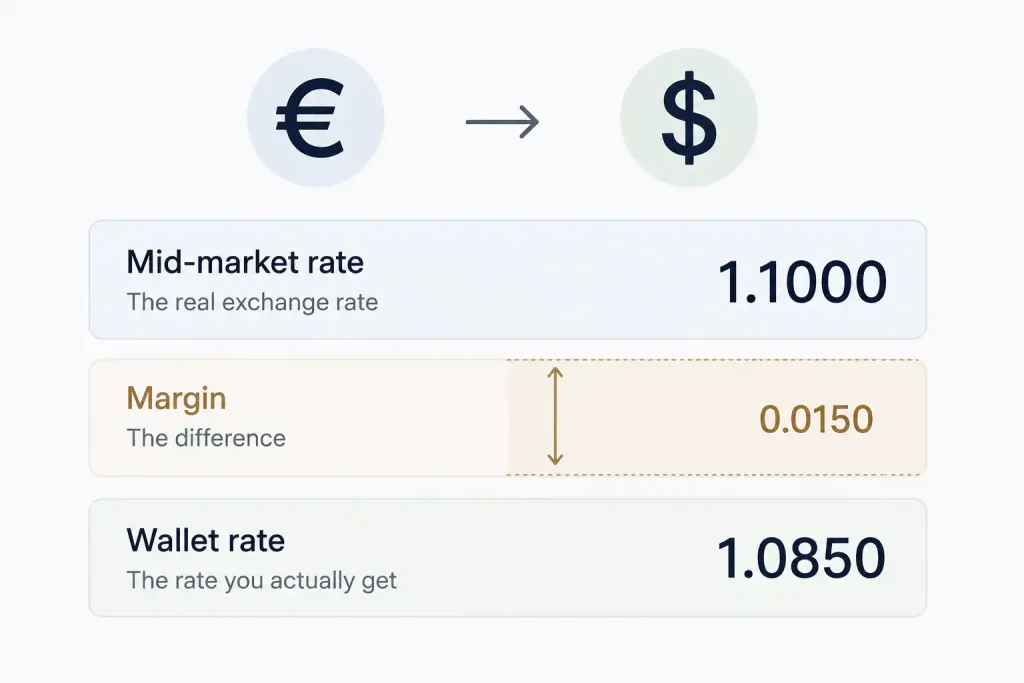
The reason this matters more than it used to is sheer volume. UK digital wallet spending stood at 269 billion pounds in 2025 and is forecast to reach 453 billion by 2030, a 68 per cent rise, and a meaningful slice of that crosses currency boundaries. As wallets carry more cross-border activity, the conversion margin quietly becomes one of the more significant costs a player pays without noticing.
Recommended online casinos
- SlotoSportBonus: 500% up to £ 10 200+ 777 FS · Payout speed: 1-3 business days
- x3betBonus: Welcome Pack 100% Up to £1.000 + 200 Free Spins · Payout speed: 1-3 business days
- AmunbetBonus: Join now and get 450% up to 2,700 GBP + 450 FS · Payout speed: 1-3 business days
- WinBeastBonus: €5000 + 500 FS + €650 Freebet · Payout speed: 1-3 business days
- NightLuckBonus: Welcome Pack + 805% Up To 6400€ + 280 FS · Payout speed: 1-3 business days
- ZombillionBonus: Welcome Pack 250% up to £4000 + 200 FS · Payout speed: 1-3 business days
- DieselwinBonus: Welcome Pack 250% up to £4000 + 200 FS · Payout speed: 1-3 business days
When Skrill Converts and When It Doesn’t
The good news is that conversion is avoidable far more often than people realise, because it only happens when two currencies actually meet. Keep them matched and the margin never fires. So the practical question is simply: where in your money trail do two different currencies collide?
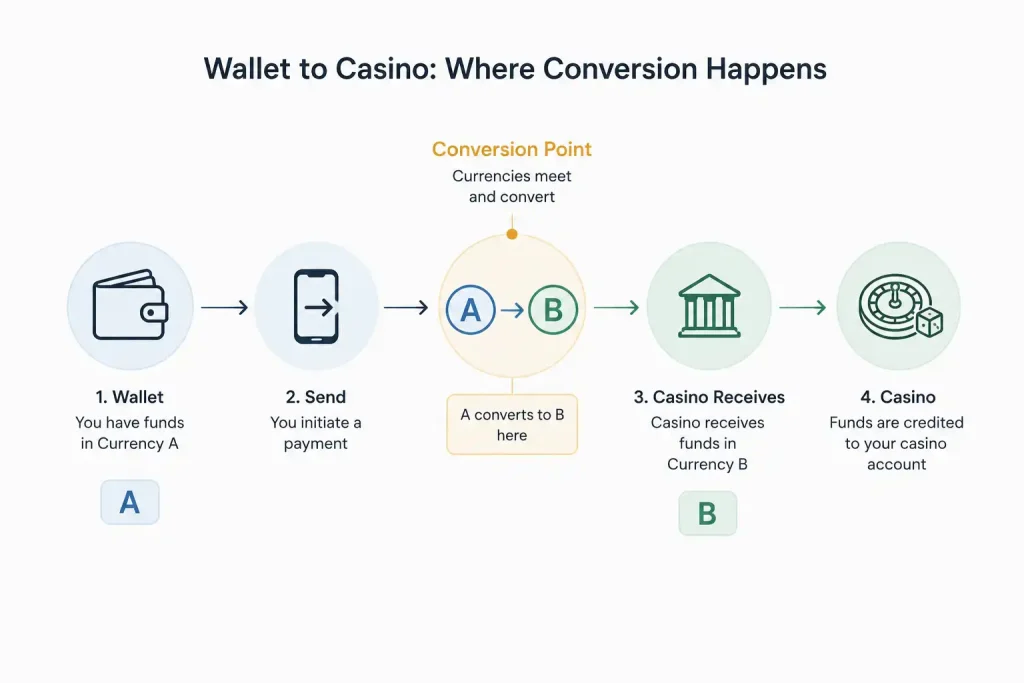
No conversion happens when your wallet currency, your deposit currency, and the casino’s settlement currency all line up. A sterling wallet funding a sterling casino in pounds moves money with no conversion margin at any step, which for a UK player at a UK-facing site is the common and ideal case. The whole journey stays in one currency, and the exchange margin has nothing to bite on.
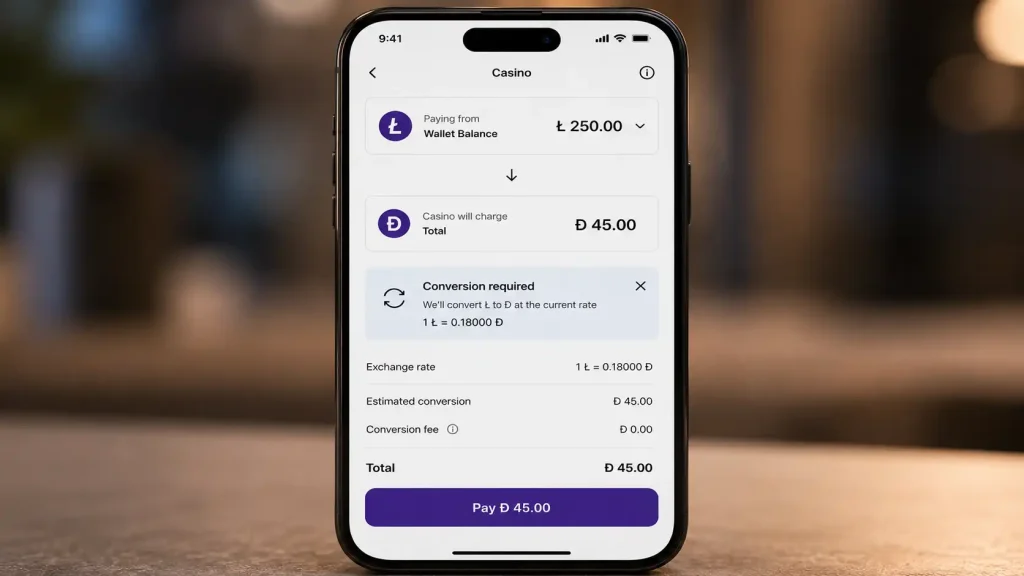
Conversion does happen the moment those currencies diverge. If your wallet holds euros and the casino bills in pounds, Skrill converts on the way in. If the casino pays winnings back in a currency your wallet does not hold, it converts on the way out. And if you fund the wallet itself from a card or bank in one currency and then spend in another, conversion can happen there too. Each crossing is a separate place the margin applies, so a player who is careless about currencies can pay it two or three times on a single round trip of money. This conversion margin sits alongside the other wallet charge players overlook, the one explained in the breakdown of the Skrill 1.99% withdrawal fee for casino players.
Reading Your Real Conversion Rate
If you want to know what conversion is actually costing you, you have to do one slightly tedious thing: compare the rate Skrill used against the mid-market rate for the same moment. The gap between them is your true cost, and it is the only honest way to measure a charge that hides inside a number.
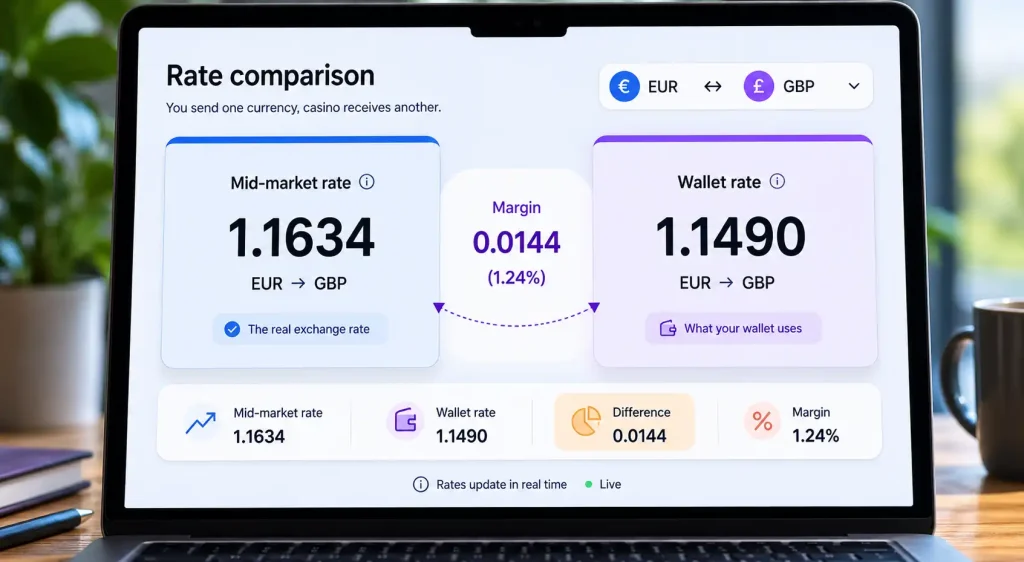
Pull the rate from your transaction record and check it against the mid-market rate for that day. The difference, expressed as a percentage of the amount converted, is the margin you paid. Do this once and you will never again be fooled by the absence of a fee line, because you will know the cost was there all along, folded into the rate. It is not unique to Skrill; this is how virtually every consumer currency conversion works, which is precisely why so few people notice it. The margin is the price of the convenience, and convenience that hides its price is the kind worth measuring rather than trusting.
Once you can read the real rate, the size of the decision becomes clear. On small, occasional conversions the margin is loose change and not worth restructuring your habits over. On large or frequent conversions, the same percentage turns into a sum worth actively avoiding. A player cashing out a four-figure win through an unnecessary conversion can lose more to the margin than to any headline fee, which is why I treat reading the rate as a core skill rather than an accounting nicety.
Keeping Your Money in One Currency
The cleanest defence against conversion costs is almost embarrassingly simple: stop letting currencies meet. Nearly every conversion charge a UK casino player pays is optional, the result of a currency mismatch that a little planning would have prevented.
The core habit is to play in sterling end to end. Hold a sterling balance in Skrill, deposit in pounds, and choose casinos that settle in pounds, so that no step in the chain ever asks the wallet to convert. For a UK-based player this is usually entirely achievable, because the sites aimed at the British market price in sterling by default. The single decision to keep everything in pounds removes the conversion margin from the entire round trip.
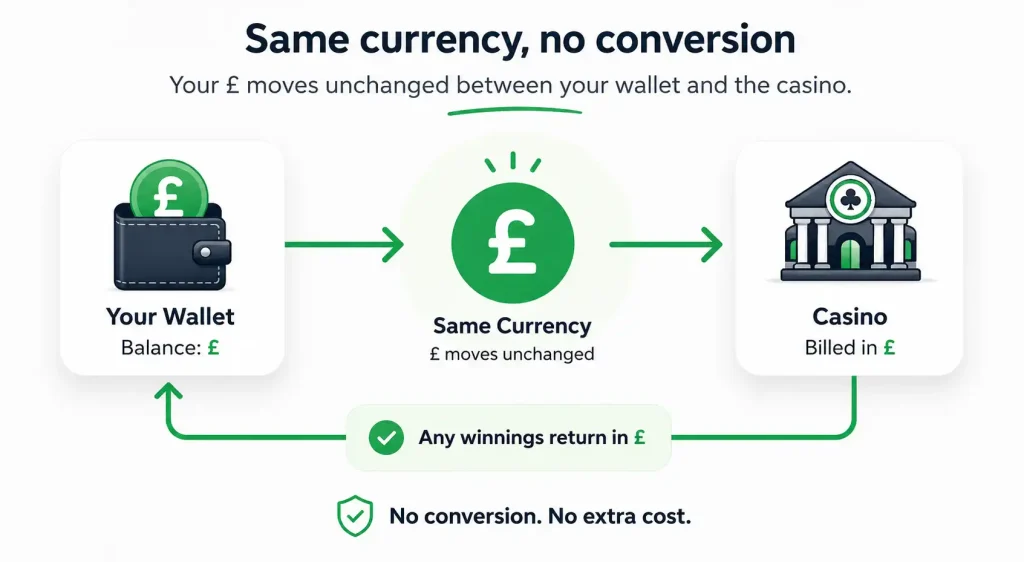
Where you genuinely must deal in another currency, concentrate the conversion into one deliberate step rather than letting it happen repeatedly. Converting once, in a single planned transaction, at a moment you have checked the rate, costs the margin once; drifting between currencies transaction by transaction pays it again and again. Think of it like buying foreign cash for a trip: you would not pop into a bureau de change every time you wanted to spend a few pounds abroad, and the same logic applies to a wallet. And if a casino only offers a currency your wallet does not hold, weigh whether the conversion cost makes that site worth using at all, because a small but constant margin on every deposit and withdrawal adds up to a quiet tax on playing there. Match your currencies, convert on purpose if you must, and the rate stops working against you.
Does Skrill charge a separate fee for currency conversion?
Not as a visible line item. The cost is built into the exchange rate as a margin over the mid-market rate, so you pay it through a slightly worse rate rather than a labelled fee. To see what it cost, compare the rate Skrill used against the mid-market rate for that day; the difference is the margin you paid.
How do I avoid conversion charges at a UK casino?
Keep one currency across the whole chain. Hold a sterling balance in Skrill, deposit in pounds, and use casinos that settle in pounds, so no step requires conversion. Conversion only happens when two different currencies meet, so matching them throughout removes the margin from your deposits and withdrawals entirely.
Articles
Prepared by the Skrill Casino editorial staff.