
UK Online Casino Game Shows: Format and Play
 Available in GB
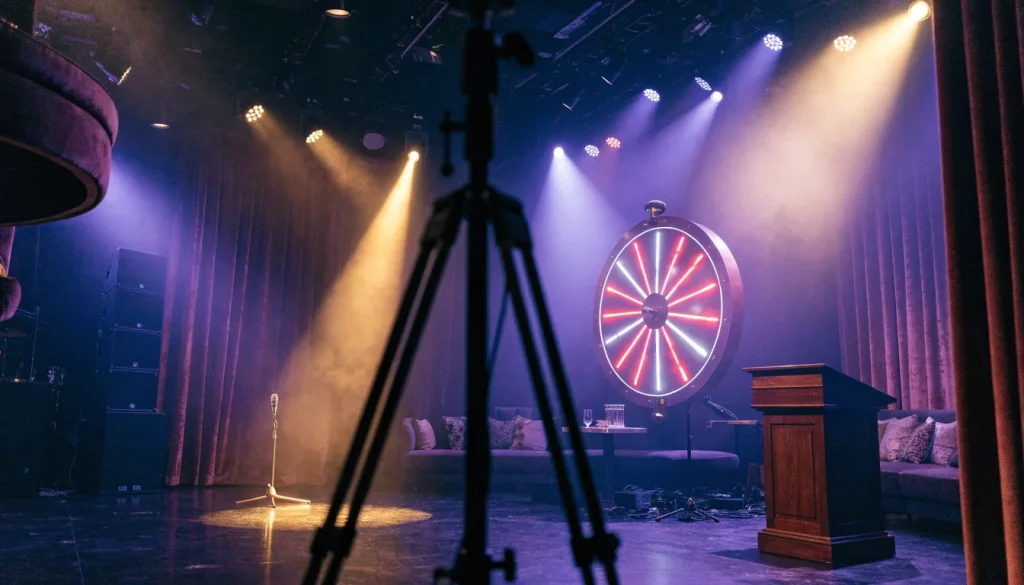
These experiences borrow the language of television, but their shared format does not mean every game has the same mechanics or presentation.
The Live Game-Show Format: Casino Play as Broadcast
A live casino game show sits at an unusual crossing: gambling borrows the language of television, while television’s familiar promise of an unfolding event is recast as an online casino experience. The attraction implied by the format is not simply a game with a screen around it. It is the sense of watching something happen in the present, with the casino’s chance-based activity presented in a style associated with entertainment. The player is invited to understand the experience as both play and performance.
That combination helps explain why the phrase “game show” carries so much weight. It brings with it a cultural memory of studios, hosts, suspense and an audience following the same unfolding moment. Those associations can shape expectations before anyone has encountered the particular product. Yet a label is not a description of its mechanics. It does not, by itself, establish how a game works, who presents it, what happens on screen or whether any particular title is available. The format can be discussed without pretending that every experience bearing its name is identical.
Best Barcrest Online Casinos in the UK: What to Check
The word “live” also does more than indicate a style. In ordinary broadcasting, it suggests that an event is taking place as it is being transmitted, rather than being presented as a recording. In casino entertainment, the term signals a wish to make play feel immediate and watchable. That is a description of the appeal, not a guarantee about any specific production. A title’s presentation and operation depend on the product itself; the broad category cannot settle those details. A useful account begins with that distinction, because the promise of immediacy can otherwise be mistaken for evidence about how the experience is made.
The word “show” contributes another layer. A game show is entertainment arranged for viewing, not merely a set of rules. In the casino setting, that association can make chance appear as a public event: something framed, watched and given a performance-like shape. This does not turn gambling into ordinary television, nor does it make the outcome less uncertain. It describes a change in presentation. The language of spectacle gives the activity a social and cultural wrapper, even when a person encounters it alone on a screen.
Online Casinos With No Limits: UK Rules Explained
There is a small irony in this transformation. Broadcast entertainment traditionally gathered people around a shared schedule; online play untethers the experience from the living room and its appointed hour. The old vocabulary travels, while the old arrangement does not necessarily follow. The game-show form can therefore feel familiar without being a simple copy of television. It borrows recognisable signals of entertainment and places them within a different setting, one governed by the rules of gambling rather than by broadcasting alone.
The appeal of play as an event
Searches for the best online casino game shows in the UK in 2026 express more than a request for a catalogue. They point to a kind of experience: gambling presented as an event rather than as an abstract interface. Some people may be drawn to the performance around play; others may simply want to understand what distinguishes this category from casino games presented in a less show-like manner. The same phrase can carry both intentions. It asks about entertainment, but it also touches a regulated activity.
That overlap matters. “Best” is an evaluative word, not a feature of the format. There is no single measure implied by the phrase. A person looking for a lively presentation may mean something different from someone who values clear rules or a familiar style of play. The category name cannot resolve those preferences, and a confident league table would make personal taste look like an objective finding.
A more careful way to understand the subject is to separate the promise of presentation from the substance of a particular game. The first concerns how casino play is framed: as something to watch, with the feeling of an event. The second concerns the rules, outcomes and conditions attached to an individual product. Those are different questions. A show-like appearance may be the reason a title catches attention, but it cannot tell anyone what the rules are or whether the experience suits them.
A show-like appearance may attract attention, but it does not define the specific rules, outcomes, or conditions of an individual game.
This distinction also explains why broad descriptions can be both useful and limited. They can place live game shows within the wider culture of online entertainment, where familiar television forms are adapted for screens and individual participation. But a category description cannot stand in for product information. The word “live” should not be treated as proof of a particular production method, and “game show” should not be taken to mean that every title follows the same pattern. The label opens the door; it does not furnish the room.
Nor does the language of entertainment cancel the fact that the activity remains gambling. A polished presentation may soften the sense of risk, but it does not alter the basic character of a chance-based wager. That is one reason the distinction between spectacle and substance deserves attention. The show can make play more legible as entertainment, yet the possibility of winning or losing remains part of the transaction. The framing changes; the category does not.
A British regulatory setting
In Great Britain, this kind of entertainment belongs within a defined regulatory environment. The UK Gambling Commission oversees gambling activity, including online casinos, and its remit covers remote gambling supplied to consumers in Great Britain even when the equipment supporting it is located elsewhere. Geography behind the screen does not, by itself, place a remote offer beyond the regulator’s reach.
The Commission’s role is not limited to a single sort of business. It grants operating licences to companies and personal licences to individuals working in regulated roles. That arrangement reflects a distinction between the organisation responsible for offering gambling and the people whose work falls within the licensing system. In the public imagination, an online casino can seem like a single website; regulation sees a set of responsibilities attached to businesses and individuals.
Amatic Online Casinos in the UK: What to Know
For a live, show-like product, the broadcast appearance does not create a separate regulatory universe. The entertainment language may borrow from television, but where gambling is being offered remotely to people in Great Britain, it remains within the Commission’s regulatory remit. The screen can make a service feel distant and borderless. The regulatory question is less theatrical: who is offering the gambling, and under whose authority?
This is a point about the framework, not an endorsement of any particular show or service. A category name cannot establish that a specific offering is authorised, just as a familiar presentation cannot answer questions about the business behind it. Regulation attaches to the gambling activity and the relevant licence holders; it is not bestowed by an entertaining format. A game can look like a broadcast and still be gambling in law and practice.
The United Kingdom is not a single, uniform legal territory in every respect, and the Commission’s stated remit here is Great Britain. That distinction matters in discussions of regulation because broad labels can blur different jurisdictions. Precision is not pedantry when the subject is a service delivered across borders; it is the difference between describing a general idea and describing where regulatory authority applies.
Reading the category without overreading it
The expression “casino game show” can describe a meeting of two familiar forms, but it leaves much unsaid. It points towards entertainment shaped like a show and offered in a gambling context. It does not prove that a particular product has a presenter, a live audience, a set format, or any specific way of determining results. Those details belong to individual offerings and should not be supplied by imagination simply because the label feels suggestive.
Attention: A label like "casino game show" suggests a mood and style but does not guarantee specific features such as a live audience or a particular presenter.
That restraint need not make the subject dull. On the contrary, it reveals something worth noticing about contemporary entertainment: forms once associated with collective viewing can be adapted for individual participation. The vocabulary of broadcast spectacle persists because it offers an immediate way to describe energy, suspense and performance. The online setting changes the relationship between audience and event, but the old cultural shorthand remains useful.
There is also a question of expectation. A person encountering the phrase may picture television first and gambling second, while another may approach it as a casino product with added presentation. Neither interpretation is inherently wrong; they emphasise different sides of the same description. But expectations should not be confused with verified properties. A name can suggest a mood. It cannot guarantee an experience.
So the broad appeal of live casino game shows lies in the way they make gambling resemble something watched as well as played. That is the defining idea at this level: casino play presented through the grammar of a show. The phrase can help identify the kind of entertainment someone is seeking, while leaving the specifics open for examination elsewhere. The performance is a frame, not a substitute for facts about the product or the regulated business offering it.
And the distinction is worth keeping. A broadcast-like surface may make gambling feel sociable, dramatic or familiar; beneath it remains an activity subject to regulation in Great Britain. The UK Gambling Commission’s authority over remote gambling offered to consumers there does not depend on where the technical equipment sits, nor on whether the experience calls itself a show. The screen may perform. The rules still apply.
Betsoft Casinos in the UK: Checking Availability
Recommended online casinos
- SlotoSportBonus: 500% up to £ 10 200+ 777 FS · Payout speed: 1-3 business days
- x3betBonus: Welcome Pack 100% Up to £1.000 + 200 Free Spins · Payout speed: 1-3 business days
- AmunbetBonus: Join now and get 450% up to 2,700 GBP + 450 FS · Payout speed: 1-3 business days
- WinBeastBonus: €5000 + 500 FS + €650 Freebet · Payout speed: 1-3 business days
- NightLuckBonus: Welcome Pack + 805% Up To 6400€ + 280 FS · Payout speed: 1-3 business days
- ZombillionBonus: Welcome Pack 250% up to £4000 + 200 FS · Payout speed: 1-3 business days
- DieselwinBonus: Welcome Pack 250% up to £4000 + 200 FS · Payout speed: 1-3 business days
Where Casino Game Shows Meet Online Casinos
A casino game show reaches its audience through a relationship between two different kinds of business. One supplies the entertainment and the means of play; the other provides the gambling account through which a customer may take part. The distinction can disappear behind a single screen, but it matters. The programme-like surface is not itself the whole casino, and the company associated with a game is not necessarily the company holding a player’s money.
In Great Britain, the operator is central to that arrangement. A business offering real-money remote gambling to consumers in England, Scotland or Wales must hold the relevant UKGC licence, wherever its key equipment is located. The Gambling Commission regulates commercial gambling in Great Britain and issues operating licences to businesses, as well as personal licences to individuals working in relevant roles. A familiar brand, an appealing interface or a game listed in a lobby does not take the place of that regulatory status.
This is a useful way to understand the phrase “online casino with live game shows”. It describes a setting in which a player may encounter a show-like gambling product within a casino service. It does not establish who produced the content, how a particular title works, or whether a named operator currently carries it. Nor does the phrase make every site that presents itself as a casino equivalent under British rules. The legal service and the entertainment attached to it are connected, but they are not interchangeable.
Do
- Verify the operator holds a UKGC licence
- Check for mandatory GamStop integration
- Confirm current game availability via operator info
Don’t
- Assume legality based on a British-looking interface
- Rely on an international catalogue for UK availability
- Confuse a software supplier with a gambling operator
The operator’s role reaches beyond providing a doorway. It is responsible for the gambling relationship with the customer: account arrangements, deposits, payouts, bonus terms and customer support. The UKGC’s rules also place duties on licensed operators around customer protection. They must check a customer’s name, address and date of birth before the first deposit, verify age before allowing deposits, and prompt customers to set a financial limit before that first deposit. If a customer lowers a limit, the change must be actioned immediately. GamStop has been mandatory for GB-licensed online operators since 2020.
These obligations are part of the service, not decorative notices around it. A show may make gambling appear communal, theatrical or conversational; the account remains an individual financial relationship between a customer and an operator. That difference is easy to overlook when production and participation are presented in the same visual frame. But the frame does not alter who accepts the deposit or carries the responsibility for a payout.
The UK regulatory boundary also matters when a site is based elsewhere. Remote operators selling into the British market must hold a UKGC licence, regardless of the country in which their equipment sits. Offshore casinos operate outside that system and do not hold a UKGC licence. Their presence on the internet does not make them part of the regulated British market, and a British-looking presentation is not evidence of British regulatory coverage. The Gambling Act 2005 governs gambling in England, Wales and Scotland; Northern Ireland has a separate legal framework.
BGaming and Amatic in UK Casinos: Provider Guide
That distinction is especially important where a search for entertainment turns into a search for a place to deposit money. A phrase such as “best live game shows casinos” may sound as if the deciding question is simply which catalogue looks most appealing. Yet the catalogue alone cannot establish the quality or legality of the service around it. In a regulated market, the operator’s status is a prior question. A game listing is an editorial or commercial presentation, not an entry in the regulator’s register.
The difference between a game supplier and an operator offers another useful lens. Suppliers create or provide gambling software; operators make that software available to customers through a licensed service. A supplier may hold a UK Gambling Software (Remote) licence, which authorises it to supply games to British operators, without being authorised to take customer deposits or pay winnings as a casino. The licence attaches to a particular role. It should not be read as a general endorsement of every site where a product might appear.
For game-show products, that separation can be less visible than it is in a conventional game catalogue. The language of a show may place a presenter, a branded environment and a gambling interface close together. Yet proximity on screen does not merge the companies or their legal responsibilities. The operator remains the party with which the customer has the gambling account; the provider’s role is tied to the software or content it supplies. The distinction is mundane, which is precisely why it is useful.
Regulatory Risk
Offshore casinos operating without a UKGC licence exist outside the regulated British market regardless of their online presentation.
Availability is also not a permanent fact simply because a product is associated with a platform. Online casino catalogues can change, and a title’s appearance in a general description does not confirm that it is currently offered to every customer, in every part of a service, or on every device. The sensible standard is not to infer availability from an old listing or from the reputation of a brand. Current operator information is the relevant place to establish what is offered. Even then, availability says nothing by itself about whether a customer should play.
The same caution applies to the word “live”. It can describe the presentation of an entertainment product, but it does not independently establish the technical arrangement, the role of a human presenter, or the rules governing a particular game. Those details belong to the product itself. Here the more important platform question is narrower: who makes the gambling service available, under what regulatory authority, and with what responsibilities towards the customer? That question remains even when the content is designed to feel less like a traditional casino game.
The British rules for remote gambling are not an incidental complication attached to a new format. They are the public framework within which licensed operators provide gambling to consumers. The Commission’s remit follows the service offered to Great Britain, not merely the location of a server or production facility. A company cannot avoid the requirement for a UKGC licence simply by placing its equipment abroad while continuing to target British customers.
Amatic Online Casinos in the UK: Games and Access
There is a social difference between watching a show and wagering through one. The former is entertainment; the latter enters the regulated sphere of gambling. A casino interface can soften that boundary with familiar visual language, but it cannot abolish it. Once real money is involved, the operator’s account controls, customer checks and responsible-gambling duties are not side matters. They are the institutional structure that separates a licensed service from a performance that merely resembles one.
This is also why broad claims about “casinos with live shows” deserve restraint. Without reliable, current confirmation, a list of supposed hosts would turn an impression into a recommendation. No operator can be treated as carrying a particular show merely because it offers remote gambling, nor can a show be treated as available in Britain because it appears in an international catalogue. Availability is specific to the operator and can change. A list would look decisive while concealing the very uncertainty that matters.
The word “best” raises a different difficulty. It invites a ranking, but a ranking needs a basis: verified availability, comparable terms and a defined measure of quality. A visually polished interface is not a measure of fair treatment; a large catalogue is not evidence of good customer support; and an entertaining presentation does not establish that a site is licensed for British customers. Without those distinctions, a league table would be more confident than informative.
Bonuses are one area where the platform relationship becomes particularly tangible. The operator sets the terms attached to its promotions, while British rules constrain what those terms may require. The UKGC’s cap on wagering requirements for bonus funds took effect in December 2025. That rule concerns bonus wagering requirements; it should not be confused with the rules for a specific game or assumed to explain how any particular show handles participation. Promotions also do not alter the operator’s licensing duties or turn a supplier into the party responsible for a customer’s account.
Since December 2025, the UKGC has implemented a cap on wagering requirements for bonus funds.
Nor should rules that specifically concern online slots be casually applied to every product described as a game show. British slot design rules prohibit autoplay and require a minimum interval between spins, while stake limits apply to online slots according to the customer’s age group. Whether a particular show-style product falls within a specific category is a question of its classification, not its name or visual style. Treating all casino entertainment as one legal category would be as misleading as treating every supplier as an operator.
The platform, then, is not just a shelf on which entertainment sits. It is the regulated point of contact where identity, money, terms and customer protections meet. A show may supply the atmosphere; the casino operator supplies the gambling account and bears the responsibilities attached to it. In Britain, the UKGC licence is the relevant dividing line for a legal remote gambling service, not a confident label, an overseas address or a familiar-looking lobby.
That boundary is less theatrical than the entertainment around it. It is also the part that should remain visible.
Distinctive Variations in Live Game-Show Play
The appeal of a live casino game show lies partly in the promise of difference. A familiar casino activity can be presented as an event, with a host, a visible setting and a sense that something is unfolding in real time. Yet “game show” is not a single style. It is a broad label for entertainment shaped around play, and the label can carry more expectation than it explains.
Amatic Slots at UK Online Casinos: What Listings Mean
One way to think about variation is through tone. A show may be imagined as exuberant, theatrical, suspenseful or restrained; those are impressions, not reliable descriptions of any particular title. The distinction matters because a name or a bright visual identity can suggest a mood before the rules or the pace are understood. A casino game show is still gambling, however lively its presentation. Entertainment may change the atmosphere around a decision without changing what that decision means.
Pace offers another lens. Some viewers associate a game-show format with quick transitions and an accumulating sense of anticipation; others expect space for commentary and spectacle. Neither expectation can safely be read from the category alone. The rhythm of play belongs to the particular production, while the broad format tells little about how long a round lasts or how often a player must make a choice. Those details are not decoration. They shape whether the experience feels like a sequence of decisions or a performance watched between decisions.
There is also a difference between participation and observation. In ordinary speech, “live” can imply immediacy and contact: the feeling that events are happening now, rather than being replayed or generated in isolation. But a broadcast-like setting does not, by itself, establish how much influence a participant has over what happens. The distinction between watching a host and taking part in a gambling outcome deserves to remain clear. A show can invite attention without making every moment interactive.
Tone
Impressions can range from exuberant and theatrical to suspenseful or restrained.
Pace
Variations include quick transitions with high anticipation or slower sequences with more commentary.
Participation
Experiences vary between active participation in outcomes and the observation of a broadcast.
That tension helps explain why the same broad category attracts different descriptions. One account may emphasise the presenter and the room; another may foreground the game, the visual treatment or the feeling of occasion. These are not necessarily competing accounts. They may be looking at different layers of the same entertainment. The difficulty begins when a vivid description of presentation is mistaken for an explanation of play.
Variation can also be considered as a question of emphasis rather than a checklist of features. Does the experience seem to revolve around a host’s performance, the anticipation of a result, or the spectacle surrounding play? Such questions describe ways of interpreting a format; they do not establish that every live game show contains the same elements, or that titles can be sorted neatly into fixed types. The category is elastic. That is part of its appeal, and part of its imprecision.
The word “show” carries its own cultural history. Television turned competitions, quizzes and staged suspense into shared entertainment, organised around a visible host and an audience’s attention. Casino versions borrow the language of performance, but they belong to a different setting: their outcomes are tied to gambling rather than simply to the pleasure of watching a contest. The resemblance can make the experience feel familiar. It should not blur the distinction.
In Britain, remote gambling sits within a licensing system overseen by the Gambling Commission. That context matters more than a production’s theatrical character: presentation does not determine whether an operator is authorised to offer gambling. Nor does an animated style make the financial dimension incidental. The show may look like entertainment first. The stakes remain part of the arrangement.
Wazdan Online Casinos in the UK: What to Verify
For some, the attraction is the social texture of a broadcast; for others, it may be the change of pace from a conventional casino interface. These are possible reasons for interest, not promises about what a particular title delivers. The distinctive quality of a game show is often less a matter of a single feature than of the way gambling is framed: as an event with a beginning, a visible sequence and a performed sense of anticipation.
That framing is powerful precisely because it feels ordinary. Television has made hosts, suspense and spectacle familiar companions. In a casino, they acquire a harder edge. The show supplies the mood; the gambling supplies the consequence.
The Live Studio and Its Place in Online Casino Play
The word “studio” carries a particular promise. It suggests a place arranged for watching: a controlled setting in which a presenter, a camera and an audience can be brought into the same frame. In a live casino game show, that image helps distinguish the experience from a solitary game interface. But the word is not a floor plan. It tells little, by itself, about where a production takes place, who appears in it or how its equipment works.
That gap matters. A screen can borrow the grammar of television without giving viewers a transparent account of the production behind it. A polished set, if present, would be part of the presentation; it would not establish who owns the platform, where the business is based or which rules govern the gambling. Appearance and accountability are separate subjects. The distinction is easy to lose when the room seems to explain everything.
The role of the studio
A polished set and human presence create a social fiction of togetherness, making an abstract software interface feel like a shared public event.
A studio’s imagined function is therefore cultural as much as practical. It offers a visible setting for an activity that otherwise happens through software and symbols. The setting can make an abstract interface feel social: there appears to be a place, and perhaps a human presence, beyond the buttons. That feeling may be central to the appeal of a live game-show casino format. It should not be mistaken for proof that a viewer knows how the production is organised.
There is an older television logic at work. Broadcast entertainment turns attention into a shared event, even when its audience is dispersed. Online play borrows that sense of occasion and places it beside the private routines of gambling: a person at home, a device in hand, a screen filling the room with a staged public moment. The studio becomes an emblem of togetherness, though the viewing itself may be solitary. A small social fiction. A useful one, perhaps, but still a fiction of the frame.
The room seen on screen, if a room is shown, is not the same thing as the institution behind the game. Sets and graphics are elements of presentation. They do not tell the viewer whether the operator has the right to offer remote gambling in Great Britain, nor do they replace the obligations attached to that permission. In Britain, a business serving customers with remote gambling must hold the relevant UKGC licence even if the equipment supporting the service sits elsewhere. Geography can shape a production; it does not, by itself, settle its regulatory position.
That separation is particularly important because the studio image encourages a certain trust. Human faces and a recognisable setting can feel more legible than a software interface. Yet visual legibility is not regulatory oversight. The UK Gambling Commission’s role concerns gambling businesses and the activities they are licensed to provide, not the atmosphere created by a set. A camera can make a scene feel immediate. It cannot certify the operator.
Amatic Online Casinos in the UK: Rules and Checks
Nor does the studio label guarantee a particular kind of performance. It may evoke presenters, conversation or a shared spectacle, but those expectations should not be treated as confirmed details of any specific production. The format’s identity can be discussed without inventing its mechanics: the idea of a live setting is part of the appeal, while the exact people, processes and technical arrangements behind an individual show require evidence of their own.
This is where the studio sits uneasily between entertainment and infrastructure. For the viewer, it may be the most visible part of the experience. For the gambling service, it is only one possible layer in a larger arrangement that includes a licensed operator and the systems through which play is offered. The visible set may be memorable; the less visible responsibilities remain decisive. Glamour has a limited jurisdiction.
There is also a social history in the studio’s familiar promise. Television taught audiences to accept that a carefully composed space could stand in for a larger event: a host addresses a camera, and strangers watching from separate homes are invited to feel present together. Online casino shows inherit that convention. They turn private attention into something styled as participation, even where the viewer’s relation to the production remains mediated by a screen.
That does not make the experience false. It makes it constructed, as entertainment generally is. The useful question is not whether a studio feels authentic, but what kind of authenticity it claims. A visible setting may lend a show personality and rhythm; it cannot, on its own, establish fairness, licensing or the location of the business responsible for the gambling. Those matters belong to different forms of evidence.
In the end, the studio is best understood as a threshold: a designed point of contact between broadcast language and online casino play. It can make gambling look like a public performance, while the legal and commercial arrangement remains elsewhere, behind the image. The set is the invitation. Not the whole institution.
Are Amatic games licensed and legal to play in the UK?
Yes. Amatic Industries holds a UK Gambling Commission remote gambling software licence, but you must play through a UKGC-licensed casino operator; Amatic does not take bets directly.
Do Amatic casinos work on mobile phones and tablets?
Amatic does not operate consumer-facing casinos. Its games generally run in a mobile browser as HTML5 games, without a download.
Can Amatic slots be played on a mobile phone in the UK?
Yes. Amatic slots generally run in a mobile browser as HTML5 games, without requiring a download.
Do Amatic casinos on GamStop have self-exclusion options?
Amatic does not run casinos itself. All UK-licensed online operators must be on GamStop, which provides a self-exclusion option.
What is Amatic Industries and when was it founded?
Amatic Industries GmbH is an Austrian business-to-business gaming software supplier, founded in 1993.
Slots
Prepared by the Skrill Casino editorial staff.