
Casinos that accept Litecoin in the UK: what to check
 Available in GB
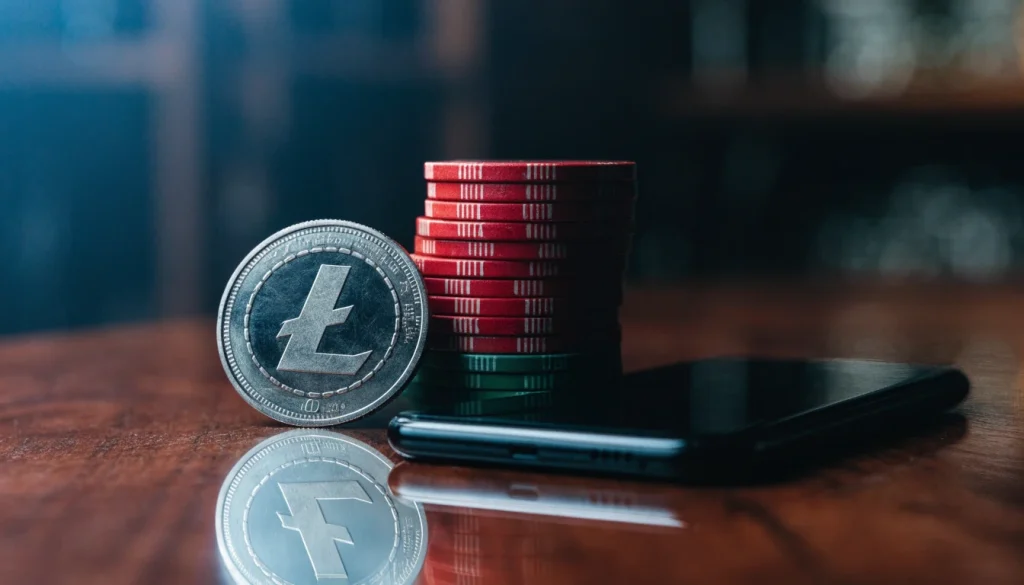
A crypto label alone does not confirm Litecoin availability for UK accounts or show how deposits and withdrawals work.
Litecoin in the UK casino cashier: what can actually be confirmed
A casino’s payment page can mention cryptocurrency without showing that Litecoin is available. A specialist review of casino payment options, for instance, lists Visa, Mastercard, bank transfer, e-wallets and several cryptocurrencies. That is evidence of a broad payment menu in the material it describes; it is not confirmation that a named casino accepts Litecoin from customers in the UK.
The distinction matters because “crypto accepted” is not a usable cashier option. It leaves unanswered which coins are supported, whether the option is open to British accounts, and whether it is available when an account holder actually reaches the payment screen. Litecoin may appear in a general description while being absent from the operator’s current list. A coin mentioned elsewhere on a site may relate to another market, an earlier version of the cashier or a service that is not offered to every customer.
That is why lists of all Litecoin casinos in the UK should be treated cautiously. A list can repeat a claim without showing what it rests on. Even a page that calls a site one of the best casinos for Litecoin deposits does not, by that wording alone, establish that the coin appears in the current UK cashier. The label is not the transaction route.
What counts as confirmation
The clearest evidence is the payment screen presented by the casino for the account and country in question. If Litecoin is shown there as a selectable deposit method, that is more specific than a general statement about cryptocurrency. The terms or payment information should also identify any country restrictions and explain the applicable conditions. The relevant details are those attached to the actual account, not an old screenshot or a broad promotional description.
The word “accepts” can conceal different situations. A site might list a coin in an information page but not offer it to UK customers; a cashier might show it only after registration; or a payment option might be temporarily unavailable. These possibilities are reasons to check the live interface, not proof that any particular operator follows one pattern. Availability can change, and a description that was accurate at one point may no longer describe the current cashier.
Casinos That Accept Maestro in the UK: What to Check
For that reason, a claim about a specific casino needs to be precise: Litecoin is available to UK customers in that casino’s current cashier. If the evidence supports only that the operator mentions cryptocurrency, the narrower wording is the honest one. Several coins being discussed together does not make them interchangeable, and it does not establish that Litecoin is among the supported choices.
Why “crypto” is not a coin name
Payment menus group unlike things under convenient headings. “Cryptocurrency” may be used as a category, while the cashier itself names individual assets, or the reverse may happen in a short review. Neither presentation settles whether Litecoin is accepted. The coin must be identified, and its availability must be tied to the relevant market and account.
This is particularly important for claims about new casino sites. A recent launch date does not establish that a particular payment method is available, and a fresh-looking page may still draw on generic descriptions. Likewise, a casino described as suitable for Android users has not thereby been shown to support Litecoin. Device access and cashier contents are separate questions; the label attached to the casino cannot answer both.
The phrase “best Litecoin casinos” also compresses two claims into one. First, the coin must genuinely be available to the intended customer. Then some defensible basis would be needed for comparing the sites. Without confirmation of the first point, rankings of bonuses, games or overall quality cannot make the underlying payment claim more reliable. A polished list is still only as sound as its evidence.
The most useful reading of the available descriptions is modest: a specialist review refers to several cryptocurrencies among the methods discussed, but that does not identify Litecoin as a confirmed option at any named casino for UK customers. It also cannot establish whether Litecoin casinos remain available to British players in 2026. That status has to be checked against a current cashier rather than inferred from a general category or an undated claim.
Do
- Check the live payment screen after signing in
- Verify country restrictions in the terms
- Confirm Litecoin is a selectable deposit method
Don’t
- Rely on general mentions of cryptocurrency
- Trust outdated screenshots or promotional descriptions
- Assume a coin is available based on a general label
This is not a technicality. A payment choice is made at the point where the account, location and cashier meet. A mention on a separate page may be informative, but it does not show what that account can select. Where the evidence stops short of naming Litecoin and confirming UK availability, the claim should stop there too.
The practical standard is plain: look for Litecoin itself in the current cashier, with the account set up for the UK market. Anything less may describe a possibility, a broader crypto offering or a past state of affairs. It does not establish a working Litecoin deposit option. A search phrase cannot do the cashier’s job.
Recommended online casinos
- SlotoSportBonus: 500% up to £ 10 200+ 777 FS · Payout speed: 1-3 business days
- x3betBonus: Welcome Pack 100% Up to £1.000 + 200 Free Spins · Payout speed: 1-3 business days
- AmunbetBonus: Join now and get 450% up to 2,700 GBP + 450 FS · Payout speed: 1-3 business days
- WinBeastBonus: €5000 + 500 FS + €650 Freebet · Payout speed: 1-3 business days
- NightLuckBonus: Welcome Pack + 805% Up To 6400€ + 280 FS · Payout speed: 1-3 business days
- ZombillionBonus: Welcome Pack 250% up to £4000 + 200 FS · Payout speed: 1-3 business days
- DieselwinBonus: Welcome Pack 250% up to £4000 + 200 FS · Payout speed: 1-3 business days
The payment routes that stand in for Litecoin
When Litecoin is not shown as an option, the alternatives are familiar parts of the UK casino cashier: debit cards, bank payments, prepaid vouchers and e-wallets. Their differences are not merely technical. Each route asks for a different relationship between the player, the bank or payment provider, and the casino. A card connects the transaction to a bank account; a voucher keeps the deposit separate from that account; an e-wallet places an intermediary between the two. The useful comparison is therefore about how money enters the casino, what the provider permits and whether the method fits the account’s terms.
Payments at UK Casinos: Deposit and Withdrawal Options
Debit cards remain a straightforward route at many UK casinos. Visa and Mastercard are commonly accepted, though a logo on a general payment page does not establish that every card product will work for every account. The casino’s cashier is the practical record of what is available at the point of transaction. Debit payments draw on money held in a bank account rather than extending credit. That distinction matters in Britain, where credit-card payments for gambling are not permitted. Card eligibility, however, is a separate matter from the broad acceptance of debit cards.
Bank transfers and open-banking services provide another way to move funds directly between accounts. A specialist casino review describes these methods as capable of supporting instant deposits and fast withdrawals at many sites; that is a report about the sites it examined, not a promise that every bank route behaves alike. The appeal is plain: fewer separate balances to manage, and a payment linked to an existing bank relationship. The practical experience can still depend on the service offered by the casino and the bank involved. Direct does not always mean simple.
Prepaid vouchers serve a different purpose. Paysafecard is a deposit-only method, so it can separate a casino payment from a bank-card transaction but does not provide a route for receiving a payout. That makes it distinct from a general-purpose payment account. The convenience of a voucher is bounded by its one-way role: it can place funds into play, but it is not a complete payment arrangement. For anyone comparing it with Litecoin, the important point is not resemblance to a cryptocurrency but the limited direction in which it moves money.
Debit Cards
Directly connected to bank accounts; Visa and Mastercard are common, though credit cards are prohibited.
Bank Transfers
Move funds directly between accounts, often supporting instant deposits and fast withdrawals.
Prepaid Vouchers
Deposit-only methods like Paysafecard that separate casino payments from bank-card transactions.
E-wallets
Intermediaries such as PayPal, Skrill, and Neteller, which may be excluded from certain promotions.
E-wallets occupy the middle ground between bank-linked payments and prepaid instruments. PayPal is valued for speed and convenience, while Skrill and Neteller appear at some casino sites. Their presence is not universal, and a specialist review reports that Skrill and Neteller are often excluded from promotions. A separate specialist review notes that PayPal may also be excluded from bonus eligibility. These are qualifications attached to reported offers, not rules that can safely be applied to every casino or promotion. An attractive payment button and a qualifying bonus are different things.
That distinction can shape the choice more than a method’s brand. A player considering an e-wallet may find that it is accepted for a transaction yet treated differently under a promotion’s terms. Another casino may set different conditions. The same caution applies to bank services and cards: payment availability does not, by itself, settle every question about the account or offer. Casino terms can be less uniform than the logos on a cashier suggest.
Litecoin appeals to some players because it is a digital currency, but searching for casinos that accept Litecoin in the UK does not make a conventional route interchangeable with it. A debit card, bank transfer, voucher or e-wallet has its own provider, account structure and rules. The substitution is functional rather than identical: each may offer a way to fund casino play, but none should be treated as Litecoin under another name. In particular, a voucher’s deposit-only character is unlike a wallet that can hold a balance, while a bank payment remains tied to the banking system.
There is also a small social history in these payment choices. Cards and bank transfers belong to ordinary household finance; vouchers borrow the logic of cash without carrying notes across a counter; e-wallets grew around the idea that an online account could mediate between people and merchants. Casinos adopted these routes because online money needs institutions, not just a button. Cryptocurrency search terms may point toward a wish for a different kind of transaction, but the available alternatives remain rooted in the payment systems that already serve the British market.
Casinos That Accept Bitcoin in the UK: What’s Known
A sensible comparison begins with the route itself, not with a claim that one method is best for everyone. Cards are familiar and widely accepted; bank payments connect directly to an account; Paysafecard is explicitly for deposits; e-wallets add another account layer and may encounter promotion conditions. Which options appear can vary by casino. The cashier is where the choice becomes concrete. The names alone are not enough.
A deposit method is only half a payment route
A payment button at the deposit stage answers one narrow question: whether the cashier will take funds through that route at that point. It does not, by itself, establish how a later withdrawal will be sent. Depositing and receiving money are separate steps in a transaction, even when the same method appears to serve both.
That distinction matters when a search for a Litecoin deposit leads to assumptions about the full journey. A casino might display a cryptocurrency among deposit methods without confirming that it can also return a payout in that currency. Nor does a reference to Litecoin tell anything definite about a debit card: a card payment and a cryptocurrency transfer are different routes, not two names for the same facility. The cashier’s withdrawal terms must be checked separately.
Why funds are sent back
In the UK, anti-money laundering rules generally require casino payouts to go back to the original payment source. This is part of the closed-loop approach to gambling transactions: money should not simply enter through one person’s account and leave through an unrelated route or to a different owner. The principle supports checks on where funds came from and who is entitled to receive them.
A casino may therefore return a withdrawal to the account or payment route used for the deposit, rather than treating the withdrawal screen as a free choice of destination. Where a payout has to be split across routes or handled another way, the operator’s stated procedure matters. A method visible in one part of the cashier should not be treated as proof of what will happen at the other end.
Casinos That Accept Dogecoin in the UK: What to Check
This is not merely a technical preference. Payment systems attach ownership information to accounts, while gambling operators have obligations to scrutinise transactions. A mismatch between the casino account and the payment account can create avoidable questions, even where the customer’s intention is straightforward. Consistent details reduce that risk: the account holder and the owner of the payment route should be the same person.
The neatest arrangement is often one named account used for both deposit and withdrawal. Neat, not magical.
Cryptocurrency and the return journey
A casino that accepts a cryptocurrency deposit would still need to explain how it handles withdrawals. The important details are not contained in the word “accepted”: they include whether payouts can return through that same route, whether another method is required, and what checks apply before funds are released. Those terms can differ between operators and can change, so old descriptions of a cashier are not reliable evidence of its present process.
This is especially relevant to claims about Litecoin casinos offering real-money play or a no-deposit promotion. A bonus label says nothing about the withdrawal route, and the appearance of a deposit option does not resolve whether winnings can be paid back in Litecoin. The promotion and the payment mechanism are separate matters. Neither should be read as a promise about the other.
The same caution applies when a cashier presents a method in a list without explaining its role. It may be deposit-only; it may be available for both directions; or withdrawals may be handled under a different procedure. The wording in the operator’s payment terms, together with the account’s actual cashier, is more useful than a general claim that the site accepts a currency.
Keeping ownership details aligned
Basic consistency can make a transaction easier to trace. The name on the gambling account, the named payment account and the intended recipient of a payout should not point to different people. That does not guarantee a particular processing time or outcome, but it reduces the chance that an ownership discrepancy becomes an obstacle.
To reduce the risk of ownership discrepancies, the name on the gambling account, the payment account, and the payout recipient should be the same person.
For anyone comparing online casinos that accept Litecoin, the practical test is therefore not just whether a deposit can be made. It is whether the operator explains the withdrawal path, how closed-loop rules apply and what happens if the original route cannot receive a payout. Deposit acceptance is an opening step, not the whole route.
Mobile slots and the payment screen
A slot can load neatly on a phone while the payment route remains unavailable. The game screen and the cashier are separate parts of a casino account: seeing a title in a mobile lobby does not show that Litecoin can be used to fund play. Nor does a desktop payment page establish that the same option will appear for a particular account on a phone.
For anyone looking for mobile slots that can be funded with Litecoin, the practical test is the cashier after signing in. The available methods may depend on the operator, the account and the point at which the payment is being made. A cryptocurrency mentioned in a general description is not confirmation that it is available to UK customers in the live cashier. The label matters less than the actual choice presented there.
The distinction is easy to overlook. Slot names and mobile layouts are visible before money moves; payment eligibility is more particular. A search for online slots payable in Litecoin can therefore lead to a game catalogue that says nothing conclusive about deposits. A page designed for a small screen may simply rearrange the same account functions, or it may present a different view. Neither appearance settles whether Litecoin is supported.
A straightforward check is to open the cashier while signed in, review the listed deposit methods and confirm whether Litecoin is explicitly offered. If the option is absent, a cryptocurrency logo elsewhere on the site does not fill the gap. If it appears, the cashier’s own terms should clarify what the method permits. A listed deposit method should not be treated as proof of withdrawal compatibility; closed-loop rules and payment ownership still matter.
Casinos that accept Interac in the UK: payment guide
Card logos provide a useful contrast, not a shortcut. A specialist review may list Visa and Mastercard, but that does not establish current UK availability or eligibility for a particular card product. Those details need to be checked in the cashier for the account being used. Payment branding is not a transaction.
The same caution applies when the game is described as a Litecoin slot. That wording can refer to a casino’s payment options rather than to a distinct kind of slot. The game itself does not certify the currency accepted by the operator, and a mobile app or browser view cannot turn an unlisted method into an available one. For real-money play, the relevant evidence is the combination of a playable account and a payment option actually shown for it.
Mobile convenience is not payment compatibility. The cashier decides.
Real-money play, account currency and conversion
A slot game can be described as playable for real money without answering a basic cashier question: what currency will the account hold? The distinction matters for anyone considering a Litecoin payment. A game’s availability and a casino’s payment options are separate matters, and neither establishes the currency in which deposits, balances or payouts are recorded.
A specialist review says that GBP is supported on the pages it examined. That is a report about those pages, not a guarantee that every account or payment route will use pounds. The account currency should be confirmed before the first transaction. If the balance is held in another currency, a payment that looks straightforward can involve conversion on the way in, during play, or when funds are returned.
For a UK player, a pounds-denominated balance makes the basic arithmetic easier to follow: the amount deposited and the amount shown in the account share a unit. That does not mean every payment method will be available in pounds, or that a crypto payment would be accepted or credited at a particular exchange rate. The cashier and the account’s stated currency are the practical evidence; a game page or a label suggesting that slots can be played for money is not enough.
Casinos That Accept POLI in the UK: Availability Checks
Currency conversion is not always presented as a separate charge. A specialist review notes that the spread built into an exchange rate can cost more than a visible flat fee. The difference may sit inside the rate rather than appear as a line item, so the apparent absence of a fee does not settle the cost. The relevant comparison is between the amount sent, the rate applied and the balance actually credited.
This is especially pertinent when a casino balance and a payment account use different currencies. A conversion can occur outside the casino, within a payment service, or as part of the casino’s own processing; the route depends on the specific accounts and cashier terms. Without checking those terms, the same nominal deposit can produce a different credited balance. Small print does the work.
The language around Litecoin slots can blur several distinct propositions: that a game is available, that it can be played for real money, and that the site accepts Litecoin. They are not interchangeable. A free-play version says nothing about deposits. A real-money slot says nothing about which cashier options are offered. Nor does a game being playable on a phone establish that its payment currency matches the player’s own.
Before real-money play, the account currency and any conversion shown for the chosen payment route need to be read together. If either remains unclear, the apparent simplicity of a deposit is only cosmetic. A currency label is not a fee schedule, and a slot title is not a payment confirmation.
Debit cards, deposits and the credit-card boundary
A Visa or Mastercard logo does not settle whether a card can fund a casino account. The important distinction is the card product: a debit card draws on money in a bank account, while a credit card borrows against a credit facility. In Britain, those are not interchangeable routes to gambling.
Credit-card payments for gambling have been banned since 14 April 2020, and the rule remains in force. Remote gambling licensees cannot accept them for casino deposits. Nor can a credit-card payment be made acceptable simply by passing it through a money service business or a digital wallet that permits credit-card funds to be used for gambling. The route may change its name; the borrowed money does not.
Credit Card Ban
Credit-card payments for gambling are prohibited in the UK; remote gambling licensees cannot accept them for casino deposits.
Debit cards are a different matter. UK casinos commonly accept debit cards, including Visa and Mastercard, but a brand’s presence on a payment page is not proof that every card bearing that mark will work. A specialist review’s payment listings include Visa and Mastercard, yet current UK availability and eligibility depend on what the casino makes available in its cashier and on the particular card product. A card issued under a familiar scheme may still be unsuitable for that transaction.
This distinction matters when a search for a Litecoin casino leads instead to a card deposit. It does not establish that Litecoin is available, nor does it make credit-card gambling permissible. A debit card may appear as a separate payment route, but the cashier is where its availability for the account and the specific card can be checked. The word “card” alone tells very little.
Card payments also sit within the rules governing remote gambling. A UK-licensed casino must not accept a credit card for gambling, whether it is presented directly or routed through a service that would still use credit-card funds. A debit card is not a workaround for that prohibition; it is a separate product funded from an account balance. If the source of funds is credit, the distinction has collapsed.
That is the boundary: debit may be eligible, subject to the cashier’s current options and the card product; credit is excluded from gambling payments. Names on plastic are not permission.
Bonuses can change which payment method makes sense
A payment option and a promotion are separate parts of a casino’s terms. A cashier may display a method for deposits, while the bonus rules exclude deposits made with it. That distinction matters when comparing Litecoin casinos with welcome offers: a bonus headline does not establish that a Litecoin deposit qualifies, or that a particular site accepts Litecoin at all.
Casinos That Accept Citadel in the UK: What to Check
The promotion’s terms should be read alongside the cashier, not as a substitute for it. The relevant details are the eligible payment methods, whether the offer applies to the first deposit, and what happens if a deposit is made through an excluded route. Where the wording is unclear, the promotion cannot safely be treated as compatible with that payment method. No code or “no deposit” label resolves the question by itself.
A specialist casino review has reported that PayPal can be excluded from bonus eligibility, despite its appeal for speed and convenience. The same type of review describes Skrill and Neteller as available at some sites, while noting that promotions may exclude them. These are reports about specific terms, not fixed rules across UK casinos. Offers change; the operator’s current promotion terms are the controlling detail.
This is a small but consequential difference. A player may value a quick payment more than a promotion, or prefer an eligible method even if it is less convenient. Neither choice is inherently better. What matters is knowing which arrangement applies before depositing, rather than discovering afterwards that the payment went through but the bonus did not attach.
Casinos That Accept E-Checks in the UK: What to Know
Searches for Litecoin slot bonuses, bonus codes or real-money play can make the offer seem like the central feature. In practice, the method’s status and the promotion’s eligibility need separate confirmation. A bonus advertised beside a list of payment methods is not proof that every listed method qualifies. Nor does a “welcome” label guarantee that a particular deposit route is included.
The clean comparison is between the exact cashier option and the exact promotion terms for the account in question. If either remains uncertain, the sensible decision is to leave the offer out of the calculation. A bonus is not a payment method.
Minimum deposits, limits and the first transaction
A small advertised minimum can make a first deposit look like a simple threshold: reach the figure and the cashier will accept it. In practice, the amount depends on the payment route, and a minimum is not a promise that every account or transaction will be treated alike. A specialist casino review reports minimum deposits in the £10–£20 range, with the stated figure varying by method. That is a guide to what may appear in an operator’s terms, not a universal price of entry.
Casinos That Accept Monzo in the UK: Payment Guide
The same caution applies to larger deposits. A specialist review notes that maximums can be set per transaction, per day or per month, and may depend both on the payment method and on account status. These are separate controls: a payment provider can impose its own ceiling, while the casino may apply limits at account level. A transaction within one limit can still exceed another. The cashier’s current figures and the account’s displayed controls matter more than a general estimate.
A low first deposit also does not settle how much money should be exposed to play. UK Gambling Commission rules require remote gambling licensees to prompt new customers to set a financial limit before their first deposit. They must also make account-level limit controls accessible. This makes the first transaction a point at which a boundary has to be considered, not merely a test of whether a payment will go through.
A deposit cap and a personal financial limit serve different purposes. The former governs what can be paid through a method or account; the latter is a control set for the player’s gambling account. Neither should be mistaken for the other. A cashier may show an amount that is technically permitted, while the account’s chosen limit is lower.
That distinction is especially relevant when a payment is described as a small Litecoin deposit. The wording alone establishes neither a minimum nor a transaction allowance. Any figure must come from the actual terms and controls attached to the account, rather than from a phrase used to describe the payment. Small print, in this case, is doing its ordinary work.
WebMoney Casinos in the UK: What to Verify
The cost of switching away from Litecoin
Moving from Litecoin to another payment route is not simply a choice between one coin and one card. The total cost can be assembled from several places: a casino charge, a payment-provider fee, a fee from a bank or card issuer, an exchange-rate spread, or a network fee. Not every transaction attracts every charge, and a fee that is visible at the outset may not be the largest one.
A specialist payment review identifies these as possible parts of the cost, rather than a fixed tariff for every casino or transaction. That distinction matters. A route advertised as free by a casino can still carry a charge elsewhere in the chain; conversely, the absence of a casino fee does not establish that a payment is cost-free. The terms of the provider and the account doing the transaction also matter.
Conversion deserves particular attention. A spread is the difference between the exchange rate applied to a transaction and a reference rate; it may be less obvious than a flat fee, while still changing the amount ultimately credited or received. A bank or payment service may apply its own rate. With cryptocurrency, network costs may also enter the calculation. The relevant comparison is therefore the amount leaving the account against the amount credited, not just the fee label on a cashier screen.
The same discipline applies when looking for an alternative to Litecoin for casino play. A method that appears inexpensive in isolation is not necessarily the cheapest for the transaction in question. There is no universal lowest-fee option: the comparison needs to include casino charges, provider costs, any bank or issuer fee, exchange-rate spread and network cost for the actual amount being sent.
This is a narrower question than which payment method is easiest to use, or which casino offers a preferred game. A site’s payment menu cannot, by itself, settle the cost. The price is in the whole route.
A short comparison before confirming a transaction can expose charges that otherwise appear on different statements or at different stages. Where the rate or fee is unclear, the advertised label is not a substitute for the provider’s terms. “Free” is often a very small word.
Casinos That Accept Wirecard in the UK: What to Check
GamStop searches, licensing and safer-gambling controls
A casino described as outside GamStop is not thereby shown to hold a UK Gambling Commission licence, and the label says nothing conclusive about whether Litecoin appears in its cashier. The same applies to claims about Litecoin slots: a game or payment method cannot establish the operator’s regulatory status. These are separate checks, not interchangeable badges.
For customers in Great Britain, remote gambling licensees selling into the market must hold the relevant UKGC licence. Online gambling is legal in the UK only through licensed and regulated sites; an offshore address does not remove the licensing requirement. Before depositing, the operator’s licence number can be checked against the Commission’s public register. A claim about being “not on GamStop” should not be treated as a substitute for that check or as a promise that an account is outside regulatory safeguards.
The safeguards begin before play. Remote operators must ask new customers to set a financial limit before their first deposit, and account-level controls must remain accessible for later changes. UKGC-licensed casinos must also provide responsible-gambling tools, including self-exclusion. Those controls are part of the regulated service, not optional decoration. A payment option does not cancel them.
There is also a route for disputes. Licensed operators must offer an internal complaints process and access to an approved Alternative Dispute Resolution service. That gives complaints a defined path beyond an exchange with customer support, though it does not establish what the outcome will be.
A search for casinos that accept Litecoin and are not connected to GamStop may combine three questions: whether an operator is licensed, whether a particular account can use Litecoin, and what exclusion arrangements apply. Each needs its own current confirmation. No label resolves all three. The UK system places responsibility on the operator to hold a licence and provide safeguards; it is not a general endorsement of every payment method or promotional description attached to a site. Dry distinction, but an important one.
Which method has the lowest fees?
There is no universally cheapest method. Compare the casino’s charges, provider or bank fees, currency-conversion spread and any network costs for the amount you plan to send.
Are fast casino withdrawals guaranteed?
No. Withdrawal speed depends on the casino’s approval process and whether your account is fully verified.
Why can a fast payout casino still delay my withdrawal?
The casino must approve the payout, and a first withdrawal may take longer while verification is completed. The payment method and, for bank transfers, cut-off times and weekends can also affect delivery.
Is Skrill available?
Yes. Skrill is available at some UK-friendly casino sites, though it may be excluded from promotions.
Payments
Written by the editors at Skrill Casino.